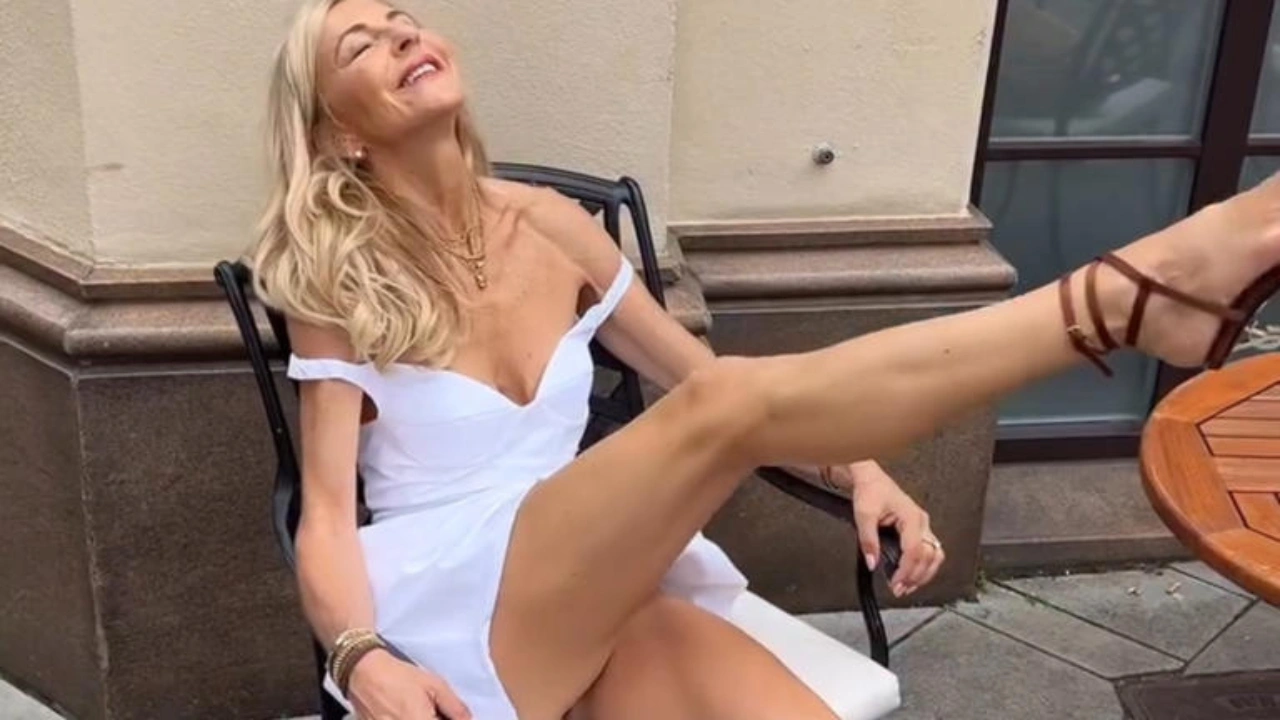
In a world where fashion advice for women over 50 has long been written in unspoken rules — subtle, restrictive, and quietly outdated — Sue Giers is rewriting the script with unapologetic confidence. At 56, the German fashion entrepreneur and content creator has become a recognizable symbol of freedom, self-expression, and age-positive style. Her message is simple and consistent: fashion doesn’t come with an expiration date, and confidence doesn’t either.
Breaking the Myth of “Age-Appropriate” Fashion
For generations, women have absorbed the idea that certain hemlines, colors, and silhouettes stop being “appropriate” once they cross a certain birthday. Sue Giers challenges that belief directly, and often visibly. Rather than defaulting to neutral tones and conservative cuts, she’s built a public style identity around micro shorts, bold silhouettes, and playful textures — pieces most style guides would still quietly steer women in her age bracket away from.
Her approach isn’t rooted in shock value. It’s rooted in choice. Giers has built her public persona around a simple internal test she encourages other women to use: rather than asking whether an outfit is “allowed,” she asks whether she genuinely likes it. If the answer is yes, she’s argued in her content, age becomes beside the point. That framing has resonated widely — her platforms have become a gathering place for women who’ve felt overlooked by a fashion industry that still, in large part, markets itself to the young.
The rules she’s pushing back against were rarely written down anywhere formally — no magazine ever published an official list of what women over 50 shouldn’t wear. But the message got absorbed anyway, through decades of catalog models who all skewed young, department store sections quietly labeled “misses” versus “petite,” and a cultural shorthand that treated visible aging as something to downplay rather than simply live in. Giers’ content works precisely because it names that unwritten rulebook out loud and then ignores it in real time, outfit by outfit.
From Wolfsburg to a Full-Fledged Fashion Brand
What separates Giers from many lifestyle influencers is that her platform isn’t built on outfit inspiration alone — it’s backed by an actual business. Raised in Wolfsburg, Germany, she launched SoSue Fashion & Lifestyle in 2016, a clothing brand she co-founded with her sister, Vanessa. The label reflects the same philosophy that defines her content: clothing chosen for mood and identity rather than a perceived age bracket.
That entrepreneurial foundation gives her online presence a different weight than a purely aspirational fashion account. When Giers talks about reclaiming personal style, she’s speaking as someone who has also built a company around that idea — not just modeled it for an audience. Running a shared family business alongside a public-facing platform also means her brand’s credibility isn’t purely performative; it has to hold up commercially, season after season, the same way any other fashion label does.
She’s also a mother of three, a detail she’s woven into her public identity rather than kept separate from it. Far from positioning motherhood and bold personal style as being in tension, her content treats them as parts of the same evolving identity — proof, in her framing, that style doesn’t need to shrink to make room for other roles a woman holds. That layering of identities — entrepreneur, mother, style figure — is part of what makes her relatable in a way a purely aesthetic account often isn’t. Her followers aren’t just watching outfits; they’re watching someone visibly juggling the same overlapping demands on time and identity that they are.
View this post on Instagram
A Social Media Following Built on Consistency
Giers has built a substantial following across platforms — with her Instagram audience numbering in the hundreds of thousands and a TikTok presence that’s amassed millions of likes — largely by showing up consistently rather than chasing single viral moments. Her content spans outfit features, skincare routines, and direct reflections on aging, confidence, and how she navigates public judgment about her choices.
In one widely shared TikTok clip styled around a Victoria’s Secret-inspired runway moment, she summed up her outlook plainly: “Age doesn’t define your beauty. Your energy does.” It’s a line that captures the throughline across most of her content — less about any specific trend, and more about permission-giving.
That tone — direct, warm, unapologetic — is a large part of why her audience skews broader than a typical fashion account. Her comment sections regularly include women decades apart in age, many of whom describe feeling encouraged to try something in their own closets they’d previously talked themselves out of. It’s also common to see younger followers in the mix, treating her less as a style icon in the traditional sense and more as evidence that the years ahead of them don’t have to mean narrowing their options.
Unlike creators who build a following around a single viral post and then struggle to sustain it, Giers’ platform has grown through repetition and reliability — posting regularly, staying visually consistent, and returning again and again to the same handful of ideas: that style is personal, that confidence is a practice rather than a trait, and that visibility past 50 is worth claiming rather than avoiding.
Fashion as a Form of Self-Respect, Not Attention-Seeking
One of the more consistent threads in Giers’ public messaging is the distinction between dressing for attention and dressing for self-respect. She’s repeatedly framed her boldest style choices not as provocation, but as an extension of simply taking herself seriously — treating personal appearance as something she controls on her own terms, rather than something dictated by outside expectation.
That framing is part of what makes her resonate with audiences well outside her own age group. Younger viewers frequently describe her as proof that aging doesn’t have to mean narrowing — that maturity and playfulness, elegance and boldness, aren’t actually opposites so much as they’ve been falsely presented as one.
It’s worth noting that this kind of visibility doesn’t come without friction. Public-facing style choices that push against convention tend to draw exactly the kind of commentary Giers is pushing back against in the first place — critical, often unsolicited opinions about what a woman “should” be wearing at her age. Rather than avoiding that friction, much of her content addresses it directly, turning the pushback itself into part of the conversation rather than something to quietly absorb off-camera.
View this post on Instagram
Calling Out Ageism in Fashion and Media
Beyond outfit content, Giers has used her platform to point at a broader, structural issue: the fashion and beauty industries’ continued underrepresentation of older women, even as brands have made real strides on other forms of diversity in advertising and casting. Her visibility functions as an implicit challenge to that gap — a working example of the market fashion brands have often overlooked.
By simply and consistently occupying digital space typically reserved for much younger creators, she’s part of a broader shift already underway in the influencer economy, where women over 50 are steadily building audiences that advertisers can no longer easily dismiss as a niche. That shift matters commercially as much as culturally: spending power among women over 50 remains significant, even as fashion marketing has historically aimed the bulk of its messaging at much younger consumers. Creators like Giers are, in effect, making the case — one post at a time — that the industry has been underestimating an entire audience.
Why Her Message Still Lands
What keeps Giers’ content from reading as a gimmick is the consistency of the underlying idea across nearly everything she posts: style should evolve with a person, not disappear as they age. She isn’t telling her audience to copy her specific choices — plenty of her followers have no interest in micro shorts or bodysuits — she’s modeling the confidence to make those decisions independently, without waiting for cultural permission.
In an attention economy still largely built around youth, that consistency is arguably her biggest asset. She isn’t positioning herself as an exception to the rule that style fades with age; she’s arguing there was never a real rule to begin with — just decades of assumptions nobody had seriously challenged until creators like her did it publicly, repeatedly, and without apology.
A Different Kind of Role Model
Part of what makes Giers stand out from the broader wave of “ageless beauty” content online is that she rarely frames her story as a transformation narrative. There’s no dramatic before-and-after, no implication that she spent decades unhappy with how she looked before arriving at some final answer. Instead, her content reads more like an ongoing conversation with herself — one she happens to be having in public, outfit by outfit, week after week.
That distinction matters. A lot of aging-related content online leans on comparison, implicitly or explicitly measuring an older woman’s appearance against a younger version of herself. Giers’ approach skips that framing almost entirely. Her posts rarely reference what she used to wear or look like; they’re focused entirely on the present outfit, the present mood, the present moment of feeling good in her own clothes. For an audience that’s spent years absorbing messaging built around reversing or disguising the effects of aging, that shift in framing — toward simply living fully in the present — is itself part of what makes her feel different from the crowded field of beauty and lifestyle creators covering similar ground.
For the women who follow her, the appeal isn’t really about hemlines or micro shorts at all. It’s about watching someone visibly refuse to shrink — and deciding, often for the first time in years, that they’re allowed to do the same.