
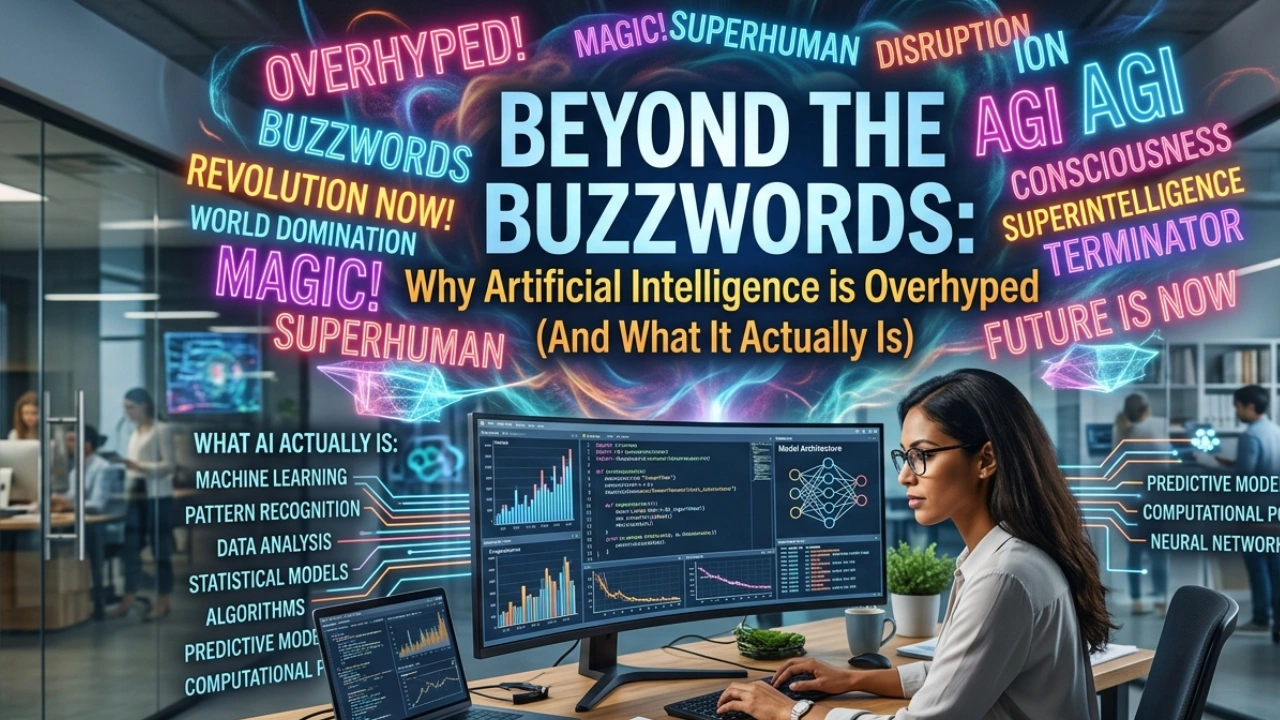
The global conversation surrounding Artificial Intelligence has achieved a state of near-religious fervor. Flip through any business journal, tech blog, or corporate earnings report, and you will be bombarded with a singular narrative: AI is a sentient, omnipresent force poised to either solve all human suffering or inadvertently trigger the apocalypse. We are told that Generative AI will autonomously run corporations, replace the entire creative workforce overnight, and achieve Artificial General Intelligence (AGI) within a matter of months.
But if you strip away the aggressive marketing campaigns, the venture capital frenzy, and the breathless media headlines, a much more grounded reality emerges.
The current state of AI is profoundly overhyped.
This is not to say that AI is useless—it is an incredibly powerful suite of software utilities. However, the gap between what AI promises to do and what it actually delivers is wider than ever. To build a sustainable digital future, we must deconstruct the myths, analyze the architectural limitations of modern models, and understand why the current AI bubble is facing a massive reality check.
The Anatomy of the AI Hype Cycle
Every transformative technology undergoes what research firms call the “Hype Cycle.” It begins with a technological trigger, rockets up to the “Peak of Inflated Expectations,” plummets into the “Trough of Disillusionment,” and eventually settles on a productive plateau. Modern AI is currently sitting precariously at the absolute peak of inflated expectations.
The core driver of this hype is the anthropomorphization of software. Because Large Language Models (LLMs) can generate text that reads as if it were written by a human, we instinctively attribute human qualities to them: intent, understanding, reasoning, and consciousness.
In reality, an LLM does not “know” anything. It is a highly advanced mathematical calculator that predicts the next most statistically probable word in a sentence based on petabytes of historical training data. It is structural pattern matching, not cognitive thought.
1. The Hallucination Problem: A Feature, Not a Bug
The most glaring piece of evidence that AI is overhyped is the persistent issue of “hallucinations”—instances where the AI confidently invents false facts, fabricated citations, or non-existent historical events.
The industry treats hallucinations as a temporary glitch that will be patched out in the next software update. However, computer scientists increasingly argue that hallucination is an foundational characteristic of how these models function. Because LLMs are predictive engines rather than fact-checking databases, they prioritize fluency over veracity.
An AI does not distinguish between a verified historical fact and a grammatically perfect lie; to the algorithm, both are simply strings of high-probability text. For high-stakes industries like medicine, law, and corporate finance, a tool that is 85% accurate but lies with absolute confidence 15% of the time is not an autonomous worker—it is a massive liability.
2. The Diminishing Returns of Scale
For the past several years, the tech elite operated under a simple doctrine: Scale is all you need. The belief was that if you keep building larger data centers, buying hundreds of thousands of advanced GPUs, and feeding the models more data, the software will naturally evolve into AGI.
However, the industry is running headfirst into the law of diminishing returns.
-
The Data Wall: Modern AI models have already consumed almost the entirety of the public, high-quality text on the internet. To keep training, tech companies are resorting to using “synthetic data” (AI-generated data used to train newer AI). This creates a dangerous feedback loop known as “Model Collapse,” where the AI gradually degrades in quality by consuming its own digital exhaust.
-
The Energy Crisis: The computing power required to train and run these massive models is structurally unsustainable. The electricity required to process a single AI search query is significantly higher than a traditional Google search, placing an immense strain on global power grids.
3. The Economic Disconnect: Where is the ROI?
The financial market has poured hundreds of billions of dollars into AI infrastructure, inflating the valuations of tech companies to historic levels. Yet, if you look at the balance sheets of the enterprises adopting AI, the Return on Investment (ROI) is remarkably low.
| The AI Promise | The Present Corporate Reality |
| Total Automated Workforce | AI primarily functions as a basic digital assistant, handling routine copy-editing, basic coding autocomplete, and primary text summarization. |
| Autonomous Product Creation | Massive human oversight is required. Every piece of AI output must be audited by human editors, developers, or lawyers to prevent legal and factual errors. |
| Explosive Revenue Growth | High subscription costs, massive API compute fees, and continuous maintenance expenses frequently outweigh the minor productivity gains. |
Many enterprises are discovering that replacing a human customer support team with an AI chatbot looks great on paper, but results in frustrated customers, lost brand loyalty, and complex backend debugging issues when the bot goes off-script.
Shifting from Hype to Real Utility
To be clear, saying AI is overhyped does not mean it is a fraud. The technology is profoundly useful when applied to narrow, specialized tasks.
When removed from the burden of trying to act like a human thinker, machine learning algorithms excel at processing massive datasets. In biochemistry, AI tools like AlphaFold have revolutionized science by predicting protein structures in days rather than decades. In logistics, predictive AI seamlessly optimizes global supply chains, reduces shipping waste, and forecasts weather patterns with remarkable accuracy. In software development, AI acts as an excellent autocomplete tool that accelerates coding workflows for experienced engineers.
The problem is not the technology itself; it is the grandiose narrative sold to the public. AI is not a digital deity capable of replacing human intellect; it is a highly sophisticated, data-driven software tool.
In Short: Reclaiming a Rational Perspective
The current artificial intelligence bubble will inevitably correct itself. The inflated stock valuations will normalize, the breathless media hype will quiet down, and the companies promising science-fiction realities will face the cold realities of corporate balance sheets.
But when the dust settles from the Trough of Disillusionment, we will be left with something far more valuable than a hyped-up buzzword: a highly efficient, deeply integrated suite of software utilities that makes human workers faster, smarter, and more precise. By stripping away the mythological status we have granted to AI, we can stop fearing an imaginary machine takeover and start using these tools for what they actually are: advanced instruments built to serve human ingenuity.
et’s stop treating LLMs like digital minds and evaluate them as tools. Here is our full reality check: 👇 https://t.co/s04cu7eItd#ArtificialIntelligence #TechHype
— genxsoft (@genxsoftinfo) July 18, 2026