
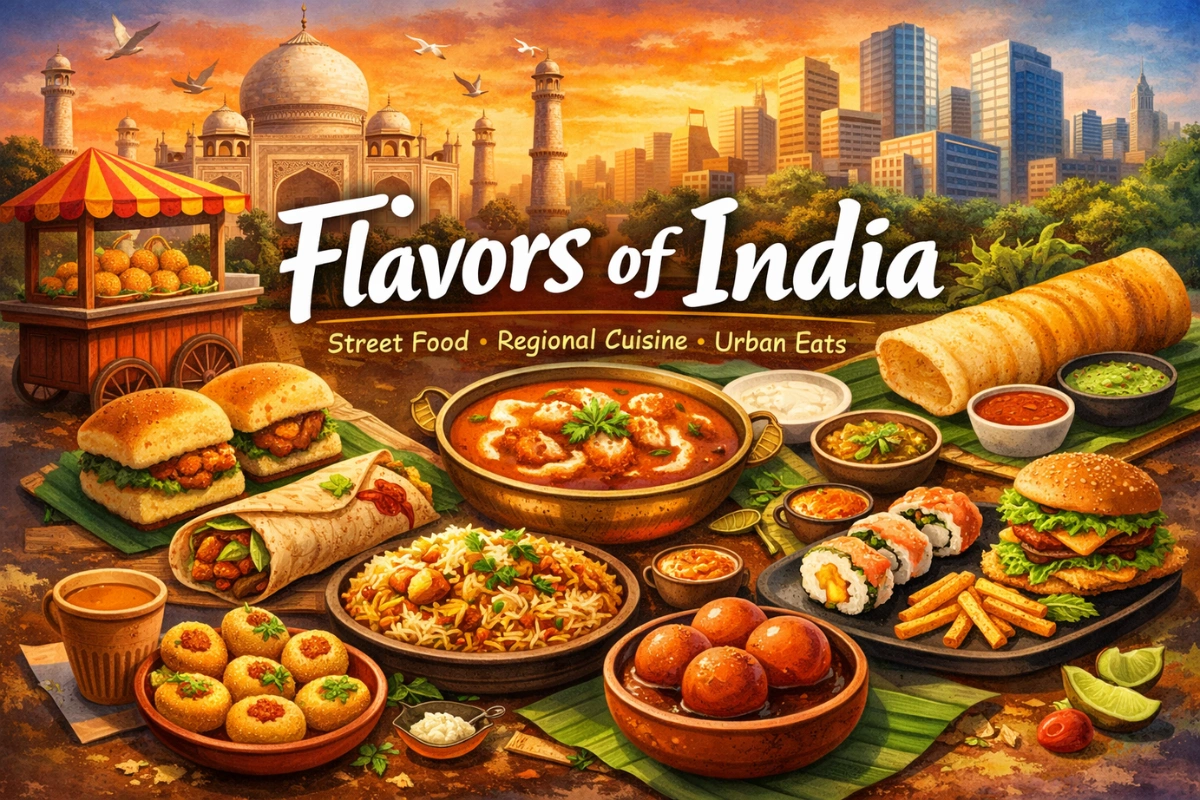
Ask anyone who has traveled through India what stayed with them the longest, and food usually tops the list before monuments or landscapes. That’s because eating in India was never meant to be a simple transaction of hunger and calories. A plate here carries a family’s history, a region’s climate, a festival’s meaning, and sometimes an entire community’s identity. Walk down any lane in any city and you’ll find that food isn’t just sold — it’s performed, shared, argued over, and passed down like an heirloom.
What makes the country’s culinary story so compelling today is the way old and new sit side by side. Roadside stalls that have fed the same neighborhood for three generations now exist a few steps away from minimalist cafés serving oat-milk lattes. Grandmothers still soak rice overnight for dosa batter while, in the same city, a cloud kitchen is packaging that same dosa for a delivery app. This piece takes a closer look at how street food, regional cooking traditions, and the fast-changing urban food scene are together writing the next chapter of Indian cuisine.
Why Food Sits at the Center of Indian Identity
Long before restaurants and ratings existed, what people ate in India was decided by geography. A coastal town leaned on fish and coconut because that’s what the land and sea offered. A dry, landlocked region built its meals around lentils and millets that could survive harsh summers. Climate shaped the ingredients, and over centuries, communities built entire belief systems, festivals, and rituals around those ingredients.
Religion and culture layered on top of geography. Fasting traditions gave rise to inventive vegetarian dishes. Trade routes brought in spices, techniques, and even entire cooking styles from Central Asia, Europe, and Southeast Asia, which were absorbed and reshaped into something distinctly local. This is why no two Indian kitchens, even within the same state, taste exactly alike — and why the phrase “Indian food” barely scratches the surface of what’s actually on offer.
Street Food: Where the Real Flavor Lives
If you want to understand a city’s personality in India, skip the five-star buffet and head to its street corners instead. Street food here isn’t a budget alternative to “real” dining — for most locals, it is the real dining experience, often more trusted and more loved than anything served on a tablecloth.
A few things explain its enduring pull:
- It’s made in front of you. There’s no mystery kitchen; you watch the batter hit the pan and the chutney get ladled on seconds before it reaches your hand.
- It’s priced for everyone. A filling meal on the street can cost a fraction of what a sit-down restaurant charges, which keeps it central to daily life rather than an occasional treat.
- It carries strong local flavor. Recipes are rarely written down; they’re inherited, tweaked, and fiercely defended by the vendor who’s been perfecting the same dish for decades.
Every city guards its own street food icons like trophies. In Delhi, it’s the sharp, tangy punch of chaat and golgappa, or a steaming plate of chole bhature that can silence an entire table. Mumbai runs on vada pav and pav bhaji — quick, spicy, and built for a city that never really slows down. Kolkata’s lanes smell of puchka and jhal muri, snacks that double as evening rituals for office-goers heading home. Head south to Chennai and the street food identity shifts entirely toward crisp dosas, soft idlis, and spiced sundal sold outside temples and beaches. In Hyderabad, the day often starts or ends with Irani chai and a warm samosa, a combination that has survived generations of changing tastes.
What ties all of this together is continuity. The vendor selling kebabs outside a Hyderabad market today is very likely using a recipe his father or grandfather built the same cart around — and that unbroken thread is exactly why street food remains the most honest window into Indian food culture.
Regional Cuisine: A Country of Many Kitchens
Calling Indian food a single cuisine is a bit like calling all of Europe’s cooking “European food.” The differences from one region to the next are enormous, shaped almost entirely by what grows locally and how people have historically lived off that land.
The north leans into richness. Creamy gravies, layered breads, and generous use of ghee and dairy define the cooking here. Dishes like butter chicken, rajma, and dal makhani are the region’s calling cards — comfort food built for cold winters and big family gatherings.
The south tells a completely different story. Rice, not wheat, forms the backbone of most meals, and the flavor profile leans on coconut, tamarind, and fresh curry leaves rather than heavy cream. Staples like dosa, idli, sambar, and rasam are light yet deeply satisfying, designed for a warmer climate and a diet built around quick digestion.
The east brings its own quiet elegance. Mustard oil and freshwater fish dominate the savory side, while the region is arguably the sweetest in the country — home to rasgulla, sandesh, and a whole universe of milk-based desserts that few other regions can rival.
The west blends contrasts beautifully — sweet, spicy, and tangy notes often show up in the same dish. Gujarati thalis balance all three tastes in a single meal, while Maharashtrian street snacks bring bold spice and quick, punchy flavor. Vegetarian cooking is especially strong here, reflecting deep-rooted cultural and religious practices.
None of these regional identities are static, either. Migration between states, inter-regional marriages, and decades of internal travel have blurred some boundaries, creating hybrid home-cooking styles that borrow freely from neighboring traditions.
Cities Are Rewriting the Rules of Dining
Urban India today looks nothing like it did even fifteen years ago, and food culture is one of the clearest signs of that shift. Café culture has exploded — not just coffee shops, but spaces built around all-day brunches, fusion menus, and Instagram-friendly plating. Cloud kitchens, which exist purely to cook for delivery apps with no physical dine-in space, have become a serious business model, letting entrepreneurs test niche cuisines without the overhead of a full restaurant.
Global influence has crept into everyday eating too. Ramen counters, Middle Eastern shawarma joints, and Korean fried chicken spots now share street corners with decades-old sweet shops. Younger diners, in particular, move fluidly between a traditional thali one night and a fusion taco stuffed with paneer tikka the next. Pop-up food festivals and collaborative dinners have turned eating out into something closer to entertainment than routine.
Delivery Apps Changed How India Eats
It’s hard to overstate how much food delivery platforms have reshaped daily habits in Indian cities. A craving for a Kolkata-style kathi roll no longer requires living anywhere near Kolkata — a few taps and it shows up at the door. These apps have also been a lifeline for small food businesses and home cooks, many of whom now run entire operations out of their kitchens without ever needing a storefront.
But convenience has a flip side. Ordering in has, for many urban households, started replacing home cooking on a regular basis, and nutritionists have raised concerns about the long-term effects of that shift. At the same time, this same convenience has sparked a counter-trend: more people are now actively tracking what goes into their food, reading ingredient lists, and choosing “healthier” menu options — something that simply wasn’t part of the conversation a decade ago.
Vegetarian Roots Meet a New Vegan Wave
India already has one of the largest vegetarian populations in the world, and that’s not a modern trend — it’s centuries old, rooted in religious practice and a farming culture built around seasonal vegetables and pulses. Everyday dishes like dal, sabzi, khichdi, and curd rice have sustained households for generations without needing meat at all.
What’s newer is the rise of veganism as a distinct urban movement. Plant-based milk, dairy-free sweets, and fully vegan cafés are now common in major cities, driven largely by younger, health-conscious consumers. Interestingly, this movement often draws inspiration from traditional Indian cooking itself, since so many regional dishes were naturally plant-based long before “vegan” became a marketing label.
Food as Connection, Not Just Consumption
Strip away the trends and delivery apps, and food in India still does what it has always done — bring people together. Meals mark festivals, seal family gatherings, and give strangers a reason to sit at the same table. Eating out in cities has increasingly become a social event in itself, a way to catch up with friends or celebrate small wins, rather than simply a way to satisfy hunger.
Where India’s Food Culture Is Headed Next
A few clear directions are emerging as India’s cities continue to grow. There’s a renewed interest in reviving regional recipes that had quietly faded from home kitchens, alongside a stronger push toward sustainably and locally sourced ingredients. Millets, once considered old-fashioned, are making a genuine comeback as health-focused diners rediscover their value. Technology will keep playing a role too, from AI-driven restaurant recommendations to smarter delivery logistics, but the underlying appeal of Indian food isn’t likely to change.
What makes India’s food culture so resilient is its refusal to pick a side between old and new. Street vendors and cloud kitchens, ghee-laden gravies and vegan cafés, family recipes and food-delivery algorithms — all of it exists at once, feeding a country that has never treated eating as an afterthought. As cities keep evolving, one thing seems certain: the flavors that built this culture aren’t going anywhere. They’re simply finding new ways to reach the table.