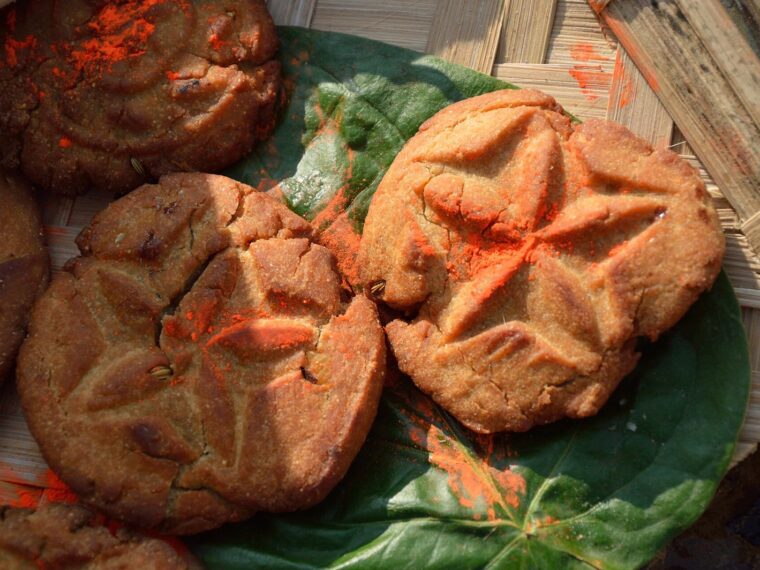
If you grew up in Bihar, Jharkhand or eastern Uttar Pradesh, the smell of thekua frying in ghee probably means one thing: Chhath is close. These crunchy, jaggery-sweet wheat cookies with their pretty pressed patterns are the heart of the Chhath prasad, packed into bamboo soops alongside sugarcane, bananas, coconut and seasonal fruit. And for families living away from home in Delhi, Mumbai, Bengaluru, London or New Jersey, making thekua in a small city kitchen is often how the festival begins.
Chhath Puja 2026 starts with Nahay Khay on Friday, November 13, followed by Kharna on Saturday, November 14, the evening Sandhya Arghya on Sunday, November 15, and the sunrise Usha Arghya on Monday, November 16. That gives you a little over two weeks to gather ingredients, find your mould, and practise a test batch if it has been a while.
Here is a simple, reliable thekua recipe, with the small details that make the difference between soft, oily thekua and the crisp, golden kind that keeps for days.
What makes a good thekua
Good thekua is crunchy outside, firm but not rock-hard inside, deeply caramel-flavoured from jaggery, and fragrant with fennel and coconut. It should not soak up oil, and it should not crack when you press the design. Three things decide all of that: a stiff dough, the right amount of ghee rubbed into the flour, and slow frying.
Ingredients (makes about 20 to 24 pieces)
- 2 cups whole wheat flour (atta), about 250 g
- 3/4 cup grated jaggery (gur), about 150 g
- 1/2 cup water, plus a little extra if needed
- 3 to 4 tbsp ghee, for the dough
- 2 to 3 tbsp grated dry coconut
- 1 tsp fennel seeds (saunf)
- 1/2 tsp green cardamom powder
- 1 tbsp finely chopped cashews or almonds (optional)
- Ghee or oil for deep frying
A wooden or metal thekua mould (saancha) gives the traditional pattern. If you do not have one, a clean fork, a new comb kept only for the kitchen, or even the back of a grater will do.
Step-by-step method
1. Melt the jaggery
Put the grated jaggery and water in a pan on low heat. Stir until it melts completely. Do not boil it into a syrup. You just want a smooth, dissolved liquid. Strain it to remove any grit, and let it cool until it is warm, not hot.
2. Rub in the ghee
In a wide bowl, mix the atta, coconut, fennel seeds, cardamom and dry fruits. Add the ghee and rub it into the flour with your fingertips for a couple of minutes. When you squeeze a handful, it should hold its shape like wet sand. This step, called moyan, is what gives thekua its crisp, slightly flaky bite.
3. Knead a stiff dough
Pour in the jaggery liquid little by little and bring it together into a stiff, tight dough. It should be firmer than roti dough. If it is too soft, the thekua will spread and absorb oil. If it is crumbly, add a teaspoon of water at a time. Cover and rest it for 10 to 15 minutes.
4. Shape
Pinch off lemon-sized balls. Press each one firmly into the greased mould, then gently ease it out. Without a mould, flatten the ball into a thick disc, about 1 cm, and press a pattern on top. Keep the shaped thekua covered with a cloth so they do not dry out.
5. Fry slowly
Heat ghee or oil in a kadhai on medium, then lower the heat. Test with a small piece of dough. It should rise slowly with gentle bubbles, not sizzle wildly. Slide in a few thekua at a time and fry on low to medium-low heat for about 4 to 5 minutes per side, until deep golden brown. Rushing this step gives you thekua that are brown outside and raw inside.
6. Cool completely
Drain on a rack or paper towel. They will feel a bit soft when hot and turn crisp as they cool. Once completely cool, store them in an airtight container.
Common mistakes and quick fixes
- Thekua turned soft after a day: the dough was too soft, or they were stored before cooling fully. Next time, knead stiffer and let them sit out longer.
- Too hard to bite: not enough ghee in the dough. Increase the moyan by a tablespoon.
- Cracked edges: the dough was too dry or rested uncovered. Add a little jaggery water and knead again.
- Oily: the oil was not hot enough, or the dough was loose. Test the oil temperature before each batch.
- Burnt outside, raw inside: the oil was too hot. Turn it down and be patient.
Making thekua for the puja
For many families, Chhath prasad is prepared with extra care. Kitchens are deep-cleaned, utensils are washed separately, and onion and garlic stay out of the kitchen during the festival. Some households grind fresh wheat for the occasion and fry the prasad only in ghee. Practices differ between families and regions, so follow what your elders do. If you are making it for the first time, a quick phone call home is the best recipe guide there is.
Many families make thekua for the evening arghya, on or just before Sandhya Arghya day. Thekua keeps well for a week or two in an airtight box, so making a small test batch earlier is fine. Just keep that batch separate from the prasad.
Easy variations (for everyday snacking, not the puja)
- Sugar thekua: swap jaggery for sugar dissolved in warm water or milk. Lighter in colour and a little crisper.
- Atta and sooji mix: replace 1/4 cup of atta with fine semolina for extra crunch.
- Air-fryer thekua: brush shaped thekua with ghee and air-fry at around 160°C, turning once, until golden. The texture is more like a biscuit, but it is a good lower-oil option for tea time.
- Nutty thekua: add more chopped almonds, cashews and a pinch of nutmeg for a richer, festive version to share with friends.
Serving and sharing
Once the arghya is complete, thekua is shared as prasad with family, neighbours and friends. It travels well, which is why so many people pack boxes of it to send to relatives in other cities. In a city flat, it is also a lovely way to introduce neighbours to Chhath. Hand over a few pieces with a little story about what the festival means to you.
If you are cooking a few sweets this festive season, our soft besan ladoo recipe uses similar pantry staples and is easy to make alongside thekua.
However far you are from the ghats this year, a kadhai of thekua frying slowly on a November evening is a very good way to bring a bit of home to wherever you are.
Featured image: Biswarup Ganguly, CC BY 3.0, via Wikimedia Commons