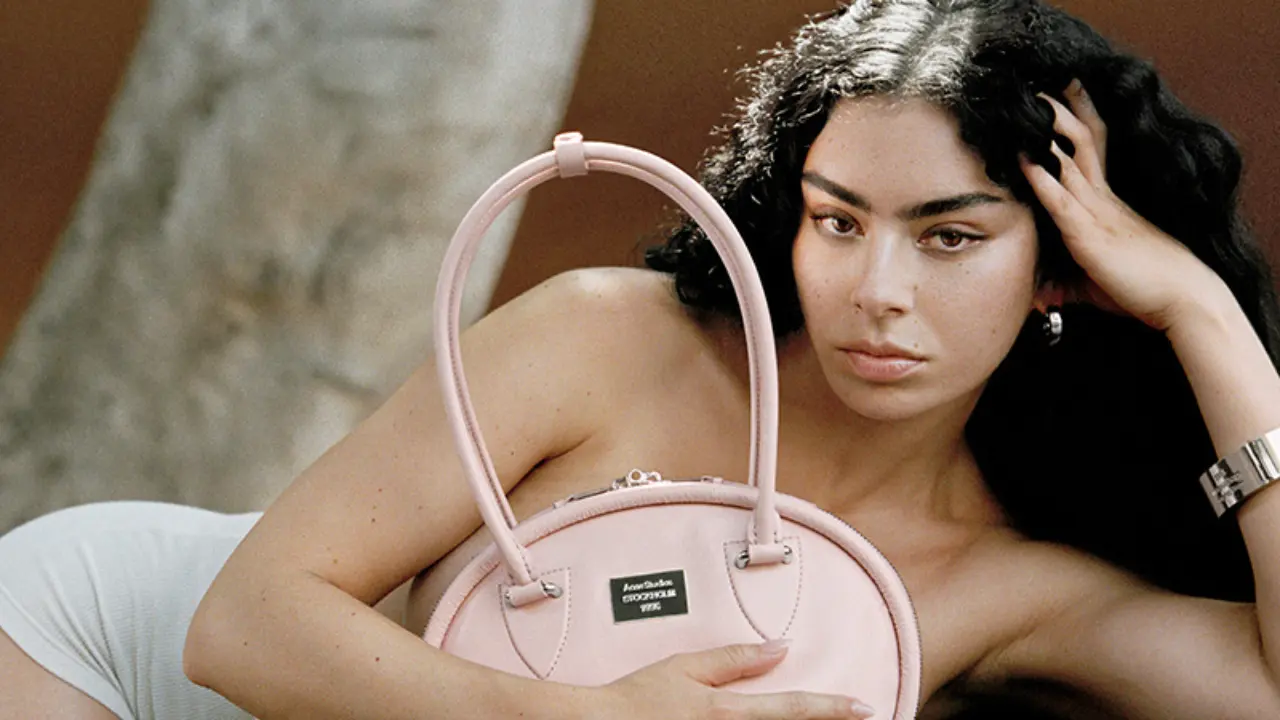
Reported and adapted from an interview by Mel Ottenberg, published in Interview Magazine.
A Pop Icon and Her Stylist, Trading Places
Charli XCX has spent the better part of two decades refusing to sit still creatively. From her earliest mixtape days to the genre-scrambling pop experiments that made Brat a cultural touchstone, she’s built a career on restlessness — musically, visually, and now, increasingly, cinematically. So it tracks that her latest extended conversation with longtime collaborator and celebrated stylist Mel Ottenberg, published in Interview Magazine, spends less time on music promotion and more time roaming across film history, fashion nostalgia, and the blurry space between interviewer and subject.
The piece is structured less like a traditional Q&A and more like an overheard conversation between two people who trust each other enough to be genuinely unfiltered. Ottenberg — Interview’s editor-in-chief and a longtime fashion director known for his work styling Rihanna, among others — is nominally the interviewer, but Charli spends much of the piece flipping the dynamic, peppering him with questions of her own about directors, remakes, and his own onscreen ambitions.
Who Gets the Credits: A Director Trivia Game
The conversation opens mid-thought, with the pair already deep into a game of naming directors they’d want to work with in some creative capacity. Charli, playing interviewer, runs Ottenberg through a list of arthouse and provocateur filmmakers — Gregg Araki, Harmony Korine, Gaspar Noé, Michael Haneke — asking whether he’d take on costume design duties for each. Ottenberg’s answers reveal a specific and fairly extreme aesthetic sensibility: he’s drawn to filmmakers who traffic in unease and spectacle rather than comfort. He describes having witnessed something like real creative magic on a past Harmony Korine set, and singles out Haneke’s Benny’s Video as a work he finds unsettling in a way he considers weirdly current, even calling it fitting for the present moment — despite noting there isn’t much room in it for costume work.
Lars von Trier comes up too, floated early as Ottenberg’s own answer to the “who would you dress” question, and it’s a choice he keeps circling back to throughout the piece, seemingly more excited by his own idea than by anything Charli proposes.
The Untouchable Remake
Where the conversation gets most animated is on the subject of Beyond the Valley of the Dolls, Russ Meyer’s 1970 cult classic, which Ottenberg names as his all-time favorite film. He’s only half-joking when he says he’d consider it a genuine catastrophe if anyone attempted a remake of either the original Valley of the Dolls or its Meyer-directed sequel without him attached as costume designer — going so far as to compare the stakes, hyperbolically, to a historic tragedy. Charli, who says she caught the film at LA’s Academy Theater, matches his enthusiasm and effectively casts him on the spot, declaring that Ottenberg will be the one to style the eventual remake, whether the project exists yet or not.
It’s a funny, telling exchange — half genuine cinephilia, half the kind of collaborative fantasy-casting that close creative partners do for sport. Meyer’s exploitation-era camp clearly holds real weight for Ottenberg’s design sensibility, and it’s easy to see why: his own styling work, both for Charli and for other artists, often leans into heightened, theatrical femininity that owes something to that same lineage.
Hailey Gates Joins the Chat
Partway through, a third voice enters the conversation: Hailey Benton Gates, actor, filmmaker, and another member of Ottenberg and Charli’s circle. Gates gets pulled into the remake game as well, floating her own pick — a Gore Vidal-related project she suggests Ottenberg will immediately understand. Charli, meanwhile, references an ongoing creative partnership of her own with Gates, describing the two of them as having already collaborated on a pair of related projects and hinting that a third, capping off something like a trilogy, may still be ahead. The details are left intentionally vague in the piece itself, more tease than announcement, but it’s a reminder that Charli’s collaborators extend well beyond the recording studio.
The Vidal tangent prompts one of the interview’s more chaotic detours, when Ottenberg brings up a comment he’d made in a separate interview earlier that same day about the writer’s rumored physical attributes. Charli immediately polices his language — not the subject matter itself, but his word choice, telling him that a certain crude term feels different, more jarring, coming from a British speaker than an American one. What follows is a bit of a bilingual comedy routine, with Charli requesting he repeat the word for effect and reacting with mock astonishment each time, before the two settle into a shared laugh and move on.
Ottenberg’s Acting Ambitions — and the One He Passed On
The conversation takes a more substantive turn when Charli asks Ottenberg about his own onscreen future. It turns out he’d been invited to appear in filmmaker Jordan Firstman’s project Club Kid — reportedly told simply to show up at a club one night and a cameo would materialize — but ultimately never went. Ottenberg’s reasoning, as he explains it, came down to timing: he wanted to let his own creative project, described in the piece as The Moment, have its moment first before taking on unrelated acting work. Charli needles him a bit for potentially passing up a role in what she jokingly suggests could have been awards-caliber work, but Ottenberg doesn’t seem to have any regrets, insisting simply that he ended up in the project he actually wanted to be part of.
Asked to describe his dream acting role, Ottenberg doesn’t hesitate: he wants to play a villain, specifically name-checking the campy, over-the-top universe of the Austin Powers films as his ideal register. He also brings up Woody Allen, noting that he’d have been an obvious fit for that kind of film in an earlier era, before quickly pivoting away given how radioactive Allen’s name has become. Charli redirects the conversation toward Robert Altman’s 1994 fashion-world satire Pret-à-Porter, suggesting Ottenberg could easily slot into that world — though he’s quick to clarify that if he ever does appear in something like it, he wants a starring role, not a walk-on.
Costuming Asia Argento, and the JT LeRoy Detour
The interview’s most substantive career reflection comes when Charli asks about Ottenberg’s early work as a costume designer on Asia Argento’s 2004 film adaptation of The Heart Is Deceitful Above All Things, based on the JT LeRoy novel. Ottenberg confirms the film’s remarkable, of-its-moment cast — Cole and Dylan Sprouse, Winona Ryder, Marilyn Manson, and Michael Pitt among them — and describes the actual process of designing the film’s look with real fondness: shooting on location in Knoxville, Tennessee, digging through the city’s thrift stores, and effectively building each character’s identity out of secondhand finds, largely improvising as he went. He’s candid that the finished film didn’t land as a critical success, but he’s unambiguous that landing the job at all was, at the time, close to a dream come true — a rare chance to design costumes for an adaptation of a book he cared about.
Underwear, Cronenberg, and a New Album Tease
True to the loose, anything-goes tone of the piece, the conversation closes on two characteristically off-kilter notes. First, a rapid-fire and fairly explicit exchange about Charli’s current underwear preferences, in which she describes a favored neon set from lingerie brand Agent Provocateur in detail. Then, a sharper turn back toward the music: Ottenberg asks Charli to name her favorite track on her forthcoming album, and she offers two contenders — one featuring a guest credit from filmmaker David Cronenberg, and another with the pointed title “Card Declined.” That prompts a final detour into Cronenberg’s filmography, with the pair trading favorites from Videodrome, Crash, The Fly, Eastern Promises, and A History of Violence, unable to settle on a single favorite between them — and closing, fittingly, on a shared appreciation for the discomforting, body-obsessed strain of horror Cronenberg has spent his career perfecting.
Why It Works
What makes the piece memorable isn’t really the album news buried near the end — it’s the texture of the friendship on display. Ottenberg and Charli have collaborated closely for years, and the interview reads less like a promotional obligation than like two people who genuinely enjoy each other’s company, riffing on shared reference points from decades of film history while occasionally, deliberately, undercutting the seriousness of it all.
The Album Behind the Album Talk: Music, Fashion, Film
The record teased in passing during the interview — the one featuring a David Cronenberg guest spot — has a name now, and it’s a fitting one: Music, Fashion, Film, Charli’s eighth studio album, released July 24, 2026, on Atlantic Records. The title is pulled directly from a lyric on “SS26,” one of the album’s early singles, and the black-and-white cover art makes the concept literal, pairing images of Velvet Underground co-founder John Cale, designer Marc Jacobs, and director Martin Scorsese — one titan representing each discipline in the title.
The eleven-track project marks a deliberate swerve from the maximalist club-pop of Brat, the 2024 album that turned its acid-green cover into a genuine cultural moment and eventually earned Charli a Grammy. Where Brat leaned into dance beats and heavy Auto-Tune, Music, Fashion, Film pushes toward a rougher, guitar-driven sound, led by singles like “Rock Music” and “SS26.” Charli has described the shift as an emotional necessity as much as an artistic one, telling Vogue that returning to another dance-leaning record would have felt discouraging, and that she was more interested in stretching what her own musical perspective could look like. Her longtime collaborator and the album’s co-producer, A.G. Cook, has framed the pivot as a response to a kind of collective overload he sees running through 2026 — a reaction to a cultural moment that feels overstuffed and relentless.
The tracklist bears out exactly what Charli teases in her conversation with Ottenberg: “Card Declined” and “No One Lasts Forever,” the latter featuring a credited guest appearance from David Cronenberg himself, sit alongside songs like “Camera,” “2007,” “Persona,” and “Magic Metal Montana.” A companion film accompanies the album, pairing visuals for all eleven songs with behind-the-scenes footage — another expression of the three-pronged concept baked into the title.
The album arrives on the heels of a genuinely packed twelve months for Charli. In February 2026, she released Wuthering Heights, a soundtrack she wrote for Emerald Fennell’s film adaptation of the Brontë novel, after Fennell approached her about contributing a song and Charli found herself unexpectedly reinvigorated by the script during a period when she’d worried her creative well had run dry. She’s also been steadily building an acting résumé alongside her music, including The Moment, an A24 mockumentary she conceived, produced, and starred in that wryly examines her own Brat-fueled celebrity. A fall tour supporting Music, Fashion, Film kicks off September 11 in Philadelphia and wraps October 23, with opening support from Underscores.
Lifestyle: A Career Lived Between Disciplines
If there’s a throughline connecting the interview’s freewheeling detours — remakes, costume design, underwear, horror movies — it’s that Charli’s day-to-day life doesn’t sort neatly into “music” and “everything else.” She shows up front row at Paris Fashion Week alongside figures like Hailey Bieber, Zoë Kravitz, and Rosé; she’s a fixture at Saint Laurent shows, where her styling leans into sharp, dark-glamour silhouettes; and she treats film sets, whether as a producer, star, or interview subject, as seriously as she treats the studio.
That omnivorous streak is exactly what shows up in her conversation with Ottenberg — the two trade movie trivia with the same ease other collaborators might trade tour gossip, and Charli’s own reference points range fluidly from 1970s exploitation cinema to body-horror auteurs. It’s a lifestyle built less around a single “pop star” identity and more around treating music, fashion, and film as three faces of the same creative instinct — which is, not coincidentally, exactly the thesis of her new album’s title.
Brand Value: Charli XCX as a Beauty and Fashion Ambassador
Charli’s cultural footprint has translated directly into brand partnerships, and nowhere more visibly than her recent appointment as a U.S. local ambassador for YSL Beauty, announced in May 2026. She joined a roster that includes Amelia Gray Hamlin, Lila Moss, and Laura Harrier, fronting a campaign built around the brand’s new Skin Affair Soft Glow Cushion Foundation — a launch YSL Beauty has called the first couture cushion foundation clutch to reach the U.S. market.
The partnership leans directly into the aesthetic she’s cultivated across Brat and now Music, Fashion, Film: smoky, lived-in glamour rather than polished perfection. In her own comments on the campaign, Charli has described her current beauty routine as fairly minimal, saying she mostly reaches for a lip product or brow gel rather than a full face of makeup, and has admitted to using a hairspray-soaked spoolie to set her brows in place. YSL Beauty’s messaging around the deal explicitly frames Charli as a “generational voice” whose influence over identity and self-expression made her a natural fit for the house’s push toward younger, edgier luxury branding.
That beauty deal sits alongside a broader pattern: Charli’s aesthetic shifts — the neon-green Brat era, the grungier rock pivot of her new album — have repeatedly become templates other brands and consumers pick up on, giving her outsized cultural leverage relative to a typical ambassador deal. It’s the same dynamic that runs through her interview with Ottenberg, where fashion, film, and music are never really treated as separate businesses, but as one continuous act of image-making.
For readers who want the full, unedited back-and-forth from the original interview — jokes, tangents, and all — the complete conversation is available at Interview Magazine.
Original interview conducted by Mel Ottenberg for Interview Magazine. This piece is an independent summary and recap; read the full conversation at interviewmagazine.com.