
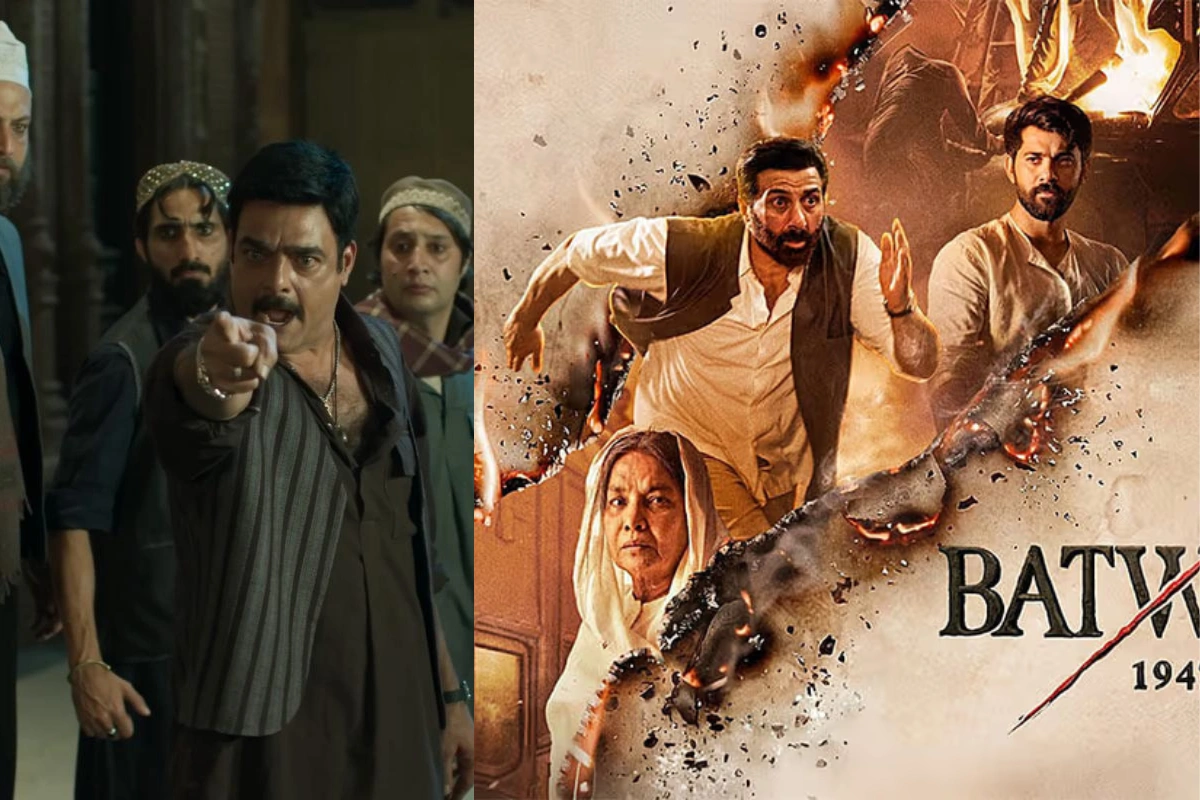
Batwara 1947 Movie Review: Yesterday I happend to get a chacne to watch Batwra 1947 at EDM cineplex. I was full of emotional to watch the complete movie with eye watering performances of Sunny Deol. Priety Zinta, Shabana Azmi and others. It is one of the best movie of Sunny Deol regardless of box office numbers. It gives a solid message to humanity over religion.
Sixteen years after it was first announced, Rajkumar Santoshi’s Batwara 1947 has finally arrived in theatres — and it lands at a moment when its central message feels almost uncomfortably relevant. Adapted from Asghar Wajahat’s celebrated Hindi play Jis Lahore Nai Dekhya, O Jamyai Nai, the film reunites Santoshi with Sunny Deol nearly three decades after their collaborations on Ghayal, Damini, and Ghatak. This time, though, the duo steps away from familiar revenge-drama territory into something quieter and more painful: the human cost of Partition.
The result is a film that’s easy to admire for what it’s trying to say, and considerably harder to fully embrace for how it says it.
The Story
The film opens on the eve of August 15, 1947. Sikander Mirza (Sunny Deol) has just finished doing his rounds shouting “Jai Hind” across Meerut when he learns of anti-Muslim riots breaking out in the city. Advised to relocate to the newly created Pakistan, he flatly refuses, insisting he’d rather die than leave. That resolve doesn’t survive long — when his home is burned down and his family threatened, he’s forced to flee toward Lahore.
His wife Hamida (Preity Zinta) and daughter Tanvir (Khushi Hajare) go with him, but his son Javed (Karan Deol) is separated from the family in the chaos. After months spent in a grim refugee camp, a pacifist poet named Habib (Ali Fazal) helps the Mirzas secure a mansion to call home.
There’s a catch, though. When the family moves in, they discover an elderly woman already living on the upper floor — Durgavati, known locally as Ratan ki Ma or simply “Mai” (played by Shabana Azmi). The house technically belongs to her, and her own family has left without her. She refuses to leave until her son comes back for her, and no amount of persuasion about moving to “Hindustan” changes her mind. What follows is a story about two families — one Muslim, one Hindu — forced to share a home and, eventually, a fight for survival against a common threat.
That threat comes in the form of Yakub (Abhimanyu Singh), a local strongman with political ambitions who claims to have killed countless people during Partition and now has his eye on the haveli, convinced there’s gold hidden somewhere inside it. Complicating matters further, Javed — who eventually crosses the border himself, carrying his own scars from the violence he witnessed in India — ends up falling in with Yakub’s group. Sikander spends much of the film’s second half trying to protect Mai from Yakub’s men, a fight that tests both his physical courage and his ability to talk a room full of hostile men down from violence with little more than conviction and rhetoric.
What Works
The performances are, by most accounts, the film’s strongest asset. Sunny Deol handles both the quieter, restrained moments and the bigger, more theatrical ones with real control — critic Taran Adarsh rated the film 3.5 out of 5, describing it as powerful and specifically praising its unconventional plot and the emotional weight the cast brings to it.
Preity Zinta, marking a significant return to the big screen after a long gap, plays Hamida as the emotional conscience of the family, and reviewers have consistently singled her out as one of the film’s better elements. Shabana Azmi, unsurprisingly, brings genuine gravity to Mai, even though some critics feel the character itself leans too heavily on a familiar, well-worn “weeping mother” archetype rather than the fuller, more community-rooted figure she was in the original play. Karan Deol, making his first on-screen appearance alongside his father, has also drawn praise — several viewers noted he manages to leave an impression despite being the newest face in a heavyweight cast.
Also read: Sue Giers: The 56-Year-Old Rewriting the Rules of Fashion After 50
Where It Falls Short
The criticism directed at Batwara 1947 mostly circles around pacing and adaptation. A story built for the stage — largely confined to one mohalla and a handful of interior spaces — doesn’t always translate naturally to the screen. What worked as an intimate, contained setting in a theatre can come across as oddly stagey in a film, especially for a story about an event as vast and disorienting as Partition. One social media reviewer put it bluntly, calling the film a lesson in why not every stage play should be adapted for cinema without rethinking its visual scale.
The character arcs have also drawn criticism for moving too quickly. Sikander and Hamida’s shift from wanting Mai evicted to risking their own safety for her happens over a relatively short stretch of screen time, and some viewers felt that transformation needed more room to breathe. A Rotten Tomatoes-aggregated critic review scored the film 2 out of 5, noting that while its message feels more relevant than ever, the storytelling itself comes across as dated and flat.
Audience reaction on the ground has been similarly split. Speaking to reporters outside a Mumbai cinema on release day, one moviegoer described the film as being more about religion than patriotism, adding that the anger and energy typically associated with a Sunny Deol film felt notably absent, and calling it a very slow watch overall. Several other viewers echoed that the first half drags considerably before the story picks up momentum in its second hour.
Not every critic came away disappointed, though. One review scored the film 4 out of 5, arguing that even when it reaches for conventional heroics a little too eagerly, its emotional core never wavers — and that the film arrives at exactly the right moment to remind audiences that people on the other side of a border aren’t abstractions.
The Bigger Picture
Comparisons to Gadar, Sunny Deol’s era-defining 2001 Partition blockbuster, were probably inevitable, and by most accounts, Batwara 1947 doesn’t quite reach that bar — audiences generally found it a decent watch, but not one that matches the earlier film’s scale or impact. It also arrives soon after Main Vaapas Aaunga, another recent Partition-set story built around a similar message of compassion across the divide, which makes some of Batwara 1947’s shortcomings feel a bit more noticeable by comparison.
A.R. Rahman’s score, surprisingly, doesn’t rank among the film’s strengths either — several reviews describe the music as underwhelming, with the old-fashioned background songs used in dramatic moments arguably reinforcing the film’s dated feel rather than elevating it.
Final Verdict
Batwara 1947 is, at its heart, a film with its priorities in the right place. Its message — that no religion is inherently bad, and that cruelty and compassion both exist on every side of every border — is one worth putting back in front of audiences, especially in the current moment. Where it stumbles is in execution: a story that felt intimate and alive on stage doesn’t always find its footing on screen, character transformations happen faster than they’re earned, and a slow first half tests patience before the film’s stronger, more urgent second hour takes over.
https://youtube.com/shorts/3ckuX3BN4-4?si=9E1SP7ln3ZgQ0eBN
If you’re going in primarily for the performances — Sunny Deol’s restrained intensity, Shabana Azmi’s quiet gravity, Preity Zinta’s grounded warmth — there’s real reward here. If you’re hoping for the sweeping, immersive Partition epic the subject deserves, Batwara 1947 gets close in spirit but doesn’t quite get there in craft.
Rating: 4.5/5 — Worth watching for the performances and its message, even if the storytelling doesn’t fully live up to either.