
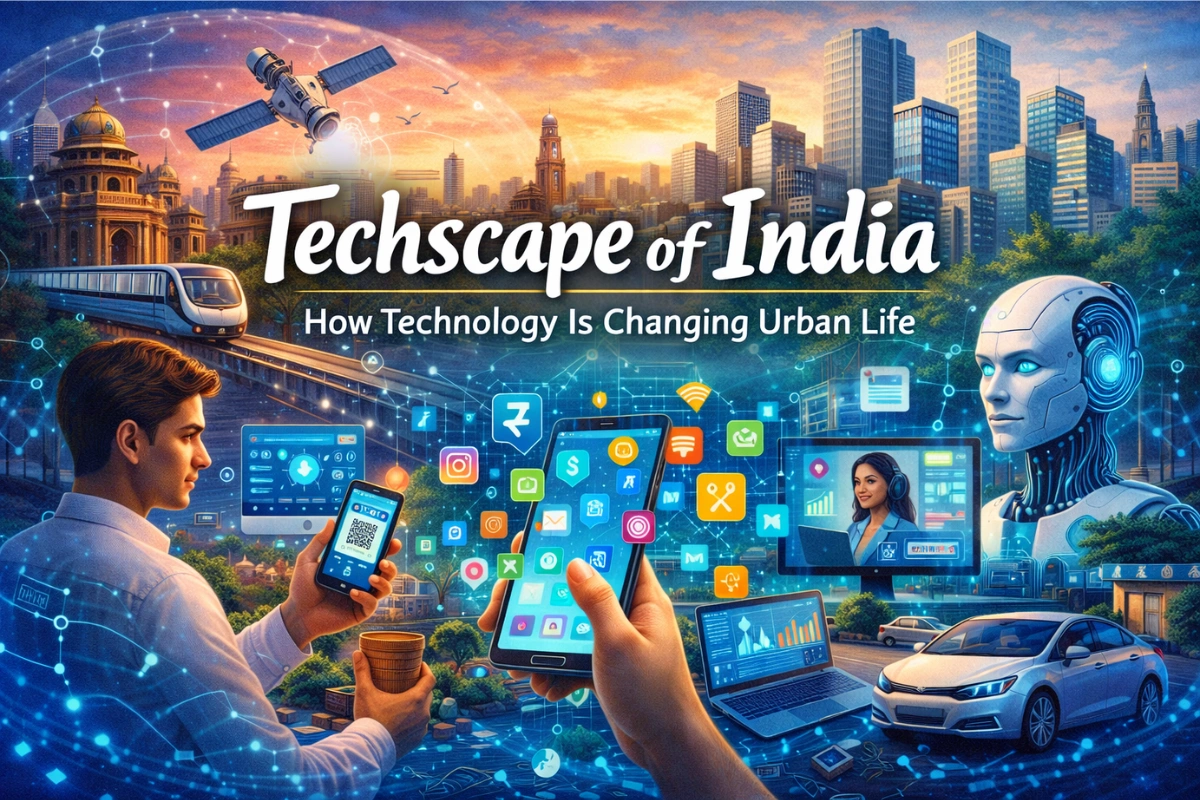
Ten years ago, paying an electricity bill meant standing in a line. Booking a cab meant waving one down on the street and hoping. Seeing a doctor meant taking half a day off work just to sit in a waiting room. None of that is how urban India runs anymore. Somewhere in the last decade, technology stopped being a convenience layered on top of daily life and became the actual infrastructure that daily life runs on.
This shift didn’t arrive with a single big announcement — it built up gradually, one app download and one UPI transaction at a time, until it reshaped how people in Indian cities work, spend, learn, and get things done. This piece looks at how that transformation happened, what it actually looks like on the ground today, and where India’s tech-driven urban life seems to be heading next.
The Groundwork That Made This Possible
None of this happened by accident. A few specific forces converged to push India’s cities into becoming genuinely digital-first environments:
- Smartphones and mobile data becoming cheap enough for almost everyone to afford
- 4G rolling out widely, with 5G now expanding into more cities
- Government-backed digital initiatives pushing adoption at scale
- A young population that picked up new technology fast and without much hesitation
None of these alone would have been enough. It was the combination — cheap devices, fast networks, institutional push, and a population willing to try new tools — that turned technology from a niche convenience into something almost everyone in urban India now relies on without a second thought.
The Smartphone Became the Remote Control for Daily Life
If there’s one device responsible for this entire shift, it’s the smartphone. For most people living in Indian cities today, one phone now handles what used to require a dozen separate errands and tools.
A single device covers messaging and social media, banking and bill payments, navigation, and increasingly, learning new skills through apps and online courses. What used to be scattered across a bank visit, a physical map, a classroom, and a landline is now compressed into one screen that fits in a pocket.
The knock-on effects are hard to overstate. People rely far less on physical services than they did even five years ago. Remote work and remote learning, both unthinkable at scale a decade back, are now routine. Daily expectations have shifted too — waiting more than a few minutes for a task that used to take an entire afternoon now feels unusual rather than normal.
Cash Is Quietly Disappearing From Urban India
India’s fintech growth isn’t just a domestic story — it’s genuinely one of the more closely watched digital shifts globally, and UPI sits right at the center of it.
Instant bank transfers, QR-code payments, and app-based wallets have gone from novelty to default across Indian cities. What’s genuinely striking is how far down this has reached — it’s not just malls and chain stores; the tea stall on the corner and the vegetable cart on the street now scan a QR code as easily as they’d count change.
Nandan Nilekani, the former Infosys CEO who advised the National Payments Corporation of India during UPI’s development, has pointed to this reach as the real measure of its success. He’s noted that UPI leveled the playing field for small businesses and individuals alike, calling it a clear example of how technology can genuinely democratize access rather than just serve those already well-off.
This shift has quietly improved financial access too. Banking has become far less intimidating for people who once avoided it, bill payments no longer require standing in a queue, and tracking spending is now something people can do in real time on their phone instead of guessing at the end of the month. For a country where a large chunk of the population was outside formal banking not long ago, that’s a meaningful shift, not just a convenience upgrade.
Work Doesn’t Look the Way It Used To
Technology hasn’t just changed how people spend or communicate — it’s rewritten what “going to work” actually means for a large share of India’s urban workforce.
Cloud-based tools, video conferencing, and digital collaboration platforms have made remote and hybrid work genuinely viable rather than an occasional exception. For a lot of professionals, this has meant less time lost to commuting, access to jobs that weren’t geographically limited before, and a work culture that’s noticeably more flexible than it was a decade ago.
Alongside this, an entirely new category of income has opened up. Freelancing platforms, content creation as an actual career path, and app-based delivery and service work have given people income streams that simply didn’t exist in the traditional employment model. For many urban Indians, especially younger ones, “career” no longer automatically means a single employer and a fixed desk.
Cities Built for Startups
India’s urban tech growth has a strong geographic center of gravity. Bengaluru, Hyderabad, Mumbai, and the Delhi NCR region have become genuine startup ecosystems, not just cities that happen to host a few tech companies.
These hubs bring together startups, incubators, accelerators, and venture capital networks in a way that feeds itself — founders, investors, and talent circulating in the same cities, building on each other’s work. And the innovation isn’t confined to one sector. Indian startups are actively building in edtech, healthtech, fintech, e-commerce, and mobility, tackling problems that are specific to Indian conditions rather than just importing solutions built elsewhere.
Google CEO Sundar Pichai, who grew up in India before eventually leading one of the world’s biggest tech companies, has spoken about this shift in fairly direct terms — describing India as a country that spent decades exporting engineering talent to companies abroad, but is now undergoing a technology revolution of its own.
When Cities Themselves Start Getting Smarter
Technology isn’t just changing how individuals live — it’s reshaping the infrastructure of cities themselves.
Smart traffic management systems, digital governance services, CCTV-backed security networks, and data-driven public services are all part of what’s loosely called the “smart city” push happening across urban India. The aim is straightforward: make city systems more efficient and improve day-to-day quality of life for residents.
The reality is messier than the pitch, though. Infrastructure gaps remain uneven between cities and even between neighbourhoods within the same city, data privacy concerns are growing alongside the amount of data being collected, and access to these smarter systems isn’t distributed equally. Balanced, inclusive development remains more of a work in progress than a finished achievement.
Healthcare and Education Went Digital, Too
Two of the most essential parts of daily life — health and education — have been reshaped just as much as banking or work.
On the healthcare side, online doctor consultations, health-monitoring apps, and digital medical records have made care noticeably more accessible, particularly for people who’d otherwise lose a full day to a routine appointment. Awareness has improved too, simply because health information is more available than it used to be.
Education has followed a similar path. Online courses, skill-focused learning platforms, and remote classrooms have made learning far more flexible than the traditional model ever allowed, letting people build career-relevant skills without necessarily sitting in a physical classroom.
Social Media Reshaped How Urban India Talks and Thinks
Communication itself has changed shape. Social platforms now influence what trends, how people form opinions, how news gets consumed, and increasingly, how individuals build a personal or professional identity online. Urban India today is more connected and, in many ways, more informed than it’s ever been.
That connectivity has a cost, though. Screen addiction, the rapid spread of misinformation, and a kind of digital burnout from constant notifications and content are real, increasingly common challenges. Awareness of these downsides — and a genuine effort to build healthier digital habits — is becoming as much a part of modern urban life as the technology itself.
The Risks That Come With Being This Connected
As more of daily life moves online, the risks scale up right alongside the convenience.
Online fraud, data breaches, and privacy concerns are no longer rare, isolated incidents — they’re now a regular part of the conversation around technology in India. That’s made digital literacy genuinely important rather than optional: understanding safe online practices, recognizing secure payment methods, and knowing how personal data is being used and protected are now basic skills for responsible digital living, not specialist knowledge.
Where India’s Techscape Goes From Here
India’s tech story is nowhere near finished. A handful of trends look set to define its next phase: artificial intelligence and automation becoming more embedded in everyday tools, electric and increasingly autonomous mobility options expanding, the Internet of Things connecting more everyday devices, and smarter, more data-informed approaches to urban planning.
There’s also a growing emphasis on making this growth sustainable rather than purely fast. That means technology aimed at reducing energy consumption, genuinely improving environmental outcomes rather than just appearing to, and closing the digital divide so that innovation doesn’t only benefit people who were already well-connected. Sustainable, inclusive innovation looks set to be the real theme of India’s next tech chapter, rather than growth for its own sake.
The Bigger Picture
India’s techscape represents something bigger than convenience — it’s genuine, ongoing transformation. In cities across the country, technology has become less of an add-on and more of the underlying layer that daily life now runs on: simplifying routine tasks, opening up new kinds of careers, and making essential services like healthcare and education more reachable than before.
The challenges are real and shouldn’t be glossed over — uneven access, privacy risks, and the mental toll of constant connectivity all need genuine attention going forward. But the overall direction is hard to miss. As Indian cities keep adopting smarter, more connected systems, technology isn’t just going to keep supporting urban life from the sidelines — it’s going to keep actively shaping what that life looks like.