Chicago Deep Dish vs. NYC Slice:Few food arguments in America run as deep, or get as heated, as Chicago deep dish versus a New York slice. It’s not really a debate about which pizza is “better” in some objective sense — it’s two completely different foods that happen to share a name, born out of two completely different cities with two completely different ideas about what pizza is supposed to do for you. Let’s actually break down the differences, the history, and where each one earns its reputation.
Where Each One Comes From
New York-style pizza traces back to Italian immigrants in the early 1900s, most famously Lombardi’s on Spring Street, widely credited as the first licensed pizzeria in the United States, opening in 1905. The style that developed from there was built around speed and portability — thin, foldable slices you could eat standing up, walking to work, or leaning against a subway pole. It’s street food in the truest sense, shaped by a city where everyone’s in a hurry and nobody has time to sit down for lunch.
Chicago deep dish has a murkier origin story, but the most widely told version credits Pizzeria Uno, opened in 1943, with inventing the style. The idea was almost the opposite of New York’s: a pizza that functioned more like a meal you sit down for, built in a deep, buttery crust that could hold significantly more cheese, sauce, and toppings than a flat pie ever could. Where New York pizza was built for a city on the move, Chicago’s version was built as a destination in itself.
The Crust: Thin and Foldable vs. Thick and Structural
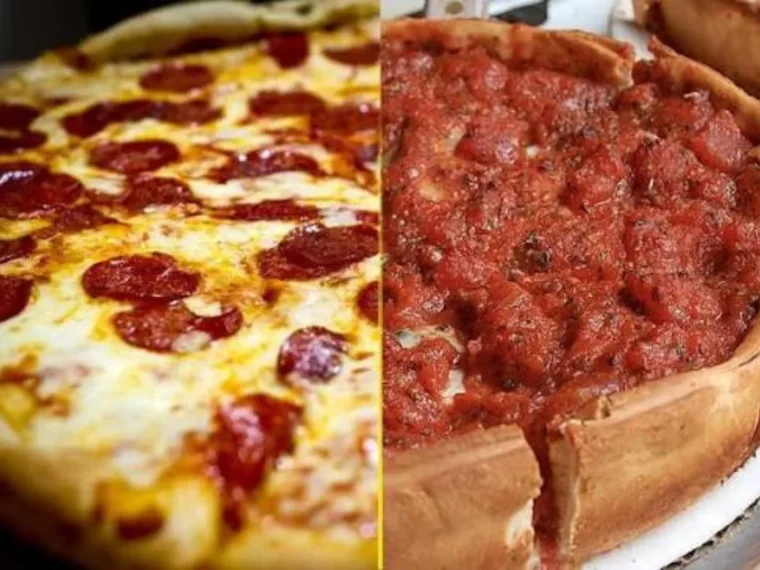
This is where the two styles diverge most dramatically. A classic New York slice has a thin, hand-tossed crust, crisp on the outside but flexible enough to fold in half lengthwise — the famous “New York fold” that lets you eat a full slice one-handed without the tip flopping down and dripping grease on your shoes. The crust isn’t really meant to stand out; it’s a vehicle for the sauce and cheese.
Chicago deep dish crust is a different animal entirely. It’s pressed into a deep, round pan — often a well-oiled steel or cast iron pan — and built up the sides like a pie crust, sometimes with a slightly flaky, almost pastry-like texture thanks to the butter or oil worked into the dough. It needs to be sturdy enough to support several inches of filling without collapsing, which means it’s inherently a knife-and-fork food. There’s no folding a deep dish slice; you’d need both hands and a plan.
The Assembly: Cheese on Top vs. Cheese on the Bottom
Here’s a detail that trips people up: Chicago deep dish is assembled backwards compared to almost every other pizza style. The order typically goes crust, then cheese (usually a thick layer of mozzarella), then toppings, and finally a chunky, often uncooked tomato sauce on top. This inverted order exists for a practical reason — with a bake time of 30 to 45 minutes, putting the sauce on top prevents the cheese underneath from burning during that longer cook.
New York pizza follows the order you’d expect: sauce directly on the dough, cheese on top, toppings scattered over that, all baked quickly at very high heat, often in a coal or gas oven running well over 500 degrees Fahrenheit. The whole pie is usually done in under 10 minutes, which is part of why it can be sold by the slice, reheated fast, and eaten on the go.
Also read: Flavors of India: Exploring Street Food, Regional Cuisine, and Urban Food Culture
The Eating Experience
A New York slice is designed around convenience. You grab it, fold it, eat it walking, and you’re done in a few minutes. The ratio of crust to cheese to sauce is balanced so that no single bite overwhelms — it’s meant to be eaten often, cheaply, and without much ceremony. That’s part of its cultural identity: pizza in New York isn’t a special occasion, it’s a daily utility, available on practically every block.
Chicago deep dish is the opposite kind of experience. A single slice can run well over a pound once you count the cheese, sauce, and typically generous toppings like sausage, and the accepted etiquette is that you eat it with a knife and fork. It’s rich enough that most people can’t finish a full pie solo, and restaurants routinely position it as a shared, sit-down meal rather than a quick bite. Ordering deep dish usually means you’re committing to at least 45 minutes between ordering and eating, since it needs real time in the oven.
Which One Wins?
Here’s the honest answer: this isn’t actually a fair fight, because the two styles aren’t trying to do the same job. If you’re judging by “which one can I eat every single day without getting sick of it or spending a fortune,” New York wins easily — thin, fast, cheap, and endlessly repeatable. If you’re judging by “which one feels like an event, a proper sit-down meal worth planning an evening around,” Chicago’s deep dish wins just as easily.
The real answer, the one both cities would probably agree on if you got them talking honestly instead of defensively, is that comparing them directly misses the point. New York pizza is street food. Chicago deep dish is a casserole in a crust. Both are excellent versions of what they’re trying to be, and the rivalry exists mostly because Americans love a good regional food fight, not because either city seriously believes their pizza and the other city’s pizza are competing for the same use case.
Where to Try Each One
If you’re in New York, classic spots like Lombardi’s, Joe’s Pizza in Greenwich Village, and Di Fara in Brooklyn all represent different eras and approaches within the New York style, from historic coal-oven pies to more modern neighborhood slice shops. In Chicago, Pizzeria Uno and its sister restaurant Pizzeria Due are the historical starting points, while Lou Malnati’s and Giordano’s represent two of the most popular modern takes on the deep dish tradition, each with slightly different approaches to crust thickness and sauce style.
The Bottom Line
Next time someone tries to pull you into the Chicago-versus-New York pizza argument, the best move might be to skip picking a side entirely. These are two genuinely different foods, built for two genuinely different purposes, by two cities with two very different relationships to time, convenience, and what a meal is supposed to feel like. The only real mistake is judging one by the standards of the other — order a Chicago deep dish expecting a quick foldable slice, and you’re going to have a confusing 45 minutes.