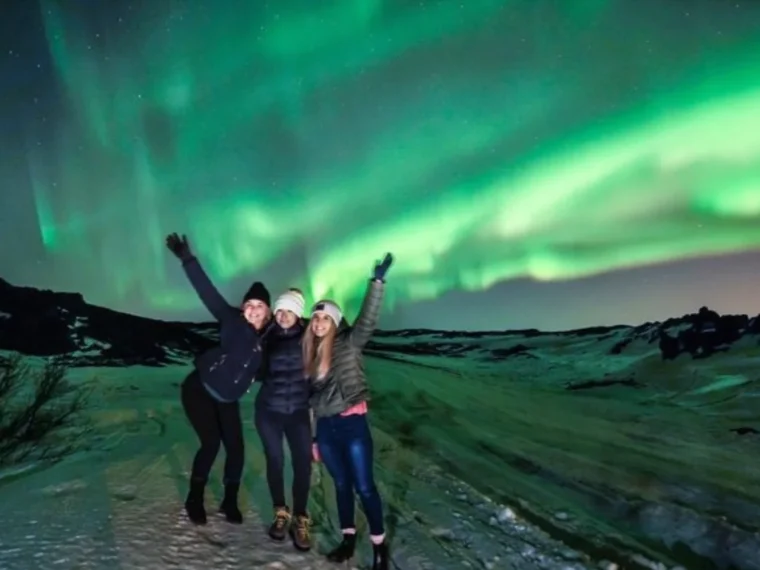
A good northern lights trip comes down to three things: going far enough north, going at the right time of year, and leaving enough nights for the weather to cooperate. This northern lights trip guide compares Iceland, Norway, Finland and Canada, explains the best months to go, and breaks down what a trip really costs, so you can choose a destination that fits both your plans and your budget.
How the Northern Lights Work, in Plain Terms
The aurora appears when charged particles from the sun hit the upper atmosphere and make it glow. You need two things to see it: activity from the sun, and a dark, clear sky. The sun has been near the busy peak of its roughly 11-year cycle, and strong displays are still likely through 2026 and into 2027. Even so, cloud cover ruins more aurora nights than a quiet sun does.
That is why the most useful planning rule is simple: book at least three or four nights in an aurora zone. One night gives you a small chance. Four nights, with flexibility to drive away from clouds, gives you a real one.
Northern Lights Trip Guide: Best Months to Go
The aurora happens year-round, but you can only see it when the sky is dark. In the far north, summer nights are too bright, so the viewing season runs from about late August or September to early April.
- September and October: milder weather, lakes and fjords not yet frozen, so you can catch reflections in the water. Fewer tourists and lower prices.
- November to January: the longest nights. In northern Norway and Finland, the sun barely rises for several weeks around the winter solstice. Colder, darker and busier over the holidays.
- February and March: a favorite for many guides. Nights are still long, there is plenty of snow for daytime activities, and the weather is often more settled. The weeks around the March equinox are also traditionally associated with good aurora activity.
Iceland: Easiest to Reach
Iceland is the shortest hop for most travelers in the UK and on the US East Coast, with frequent flights into Keflavik. You can see the aurora from rural areas a short drive from Reykjavik, and the Golden Circle, south coast waterfalls and geothermal pools fill the daytime.
The catch: Iceland’s weather is changeable and cloud is common. Renting a car or joining a tour that chases clear skies makes a real difference. Winter driving can be dangerous, so check road and weather conditions every day.
Typical costs: Iceland is one of the most expensive countries in Europe. Budget roughly USD 150 to USD 250 a night for a basic hotel or guesthouse in winter, USD 60 to USD 120 per person for a northern lights bus or minibus tour, and plenty for food, since a simple restaurant meal often costs USD 30 or more.
Norway: Tromso and the Arctic Coast
Tromso sits well inside the auroral oval and has a lively small-city feel, with good restaurants and many tour operators. The coast is milder than you might expect because of the Gulf Stream, though it is also wet. Guides often drive inland, sometimes toward the Finnish border, to find clearer skies. The Lofoten Islands are more dramatic, but harder to reach and rely more on a rental car.
Typical costs: Norway is pricey too. Expect around USD 150 to USD 300 a night for a central hotel in peak months, and roughly USD 120 to USD 250 per person for a guided aurora chase. Dog sledding and whale-watching trips are extra and usually cost more.
Finland: Lapland and Glass Igloos
Finnish Lapland, including Rovaniemi, Levi, Saariselka and Ivalo, is inland and flat, with dark forests and less coastal cloud. It is the place for the classic image of watching the aurora from a heated glass igloo or a cabin by a frozen lake.
Typical costs: Standard hotels and cabins can be reasonable outside the Christmas weeks, often around USD 120 to USD 220 a night. Glass igloos and aurora cabins are the splurge, commonly several hundred US dollars a night and much more around Christmas. Aurora tours by bus, snowmobile or reindeer sleigh range widely depending on the activity.
Canada: Yellowknife, Whitehorse and Churchill
For North American travelers, Canada can mean a single domestic or short flight instead of a long-haul trip. Yellowknife in the Northwest Territories is one of the most reliable spots in the world, thanks to its location under the auroral oval and a dry, often clear winter climate. Whitehorse in the Yukon offers mountains and hot springs. Churchill, Manitoba, is famous for polar bears in the fall and aurora in the winter, but it is remote and expensive.
Typical costs: Yellowknife aurora packages of three or four nights, including a lodge viewing site, often fall somewhere around CAD 1,200 to CAD 3,000 per person before flights. Winter temperatures can drop below minus 30 degrees Celsius, so many operators rent warm parkas and boots.
A Rough Budget Comparison
For a four-night trip for one person, excluding international flights, here is a ballpark range based on mid-range choices:
- Iceland: about USD 1,000 to USD 1,800
- Tromso, Norway: about USD 1,000 to USD 1,900
- Finnish Lapland: about USD 900 to USD 1,700 with standard rooms, and much more with igloo nights
- Yellowknife, Canada: about USD 1,000 to USD 2,200 with a package
These are planning estimates, not quotes. Prices change by season, exchange rate and how early you book.
Tips to Improve Your Chances
- Watch the forecast, not just the calendar. The NOAA Space Weather Prediction Center aurora forecast shows short-term activity, and local cloud forecasts matter just as much.
- Stay up late. Activity often peaks between about 9 pm and 2 am local time.
- Get away from lights. Even a small town glow washes out faint displays.
- Bring a tripod. Modern phones can capture the aurora in night mode, but a steady base helps.
- Dress properly. Thermal base layers, a warm mid-layer, insulated boots and spare gloves will keep you outside longer.
If you would rather pair a winter trip with snowy mountain scenery than polar nights, our guide to Switzerland in winter covers another classic cold-weather trip.
FAQ
What is the best month to see the northern lights?
Any month from September to March can work. February and March are popular because nights are still long and the weather is often more settled.
Which country is best for the northern lights?
Iceland is easiest to reach, Norway offers fjord scenery, Finland has the glass igloos, and Yellowknife in Canada has some of the clearest winter skies.
Can I see the northern lights from a city?
Sometimes during strong displays, but you will see far more from a dark spot outside town.
There is no guaranteed northern lights trip, but you can stack the odds. Choose a spot inside the auroral oval, go between September and March, stay at least three or four nights and keep your evenings free. Whether you pick Iceland, Tromso, Lapland or Yellowknife, the moment the sky starts to move is worth the cold.