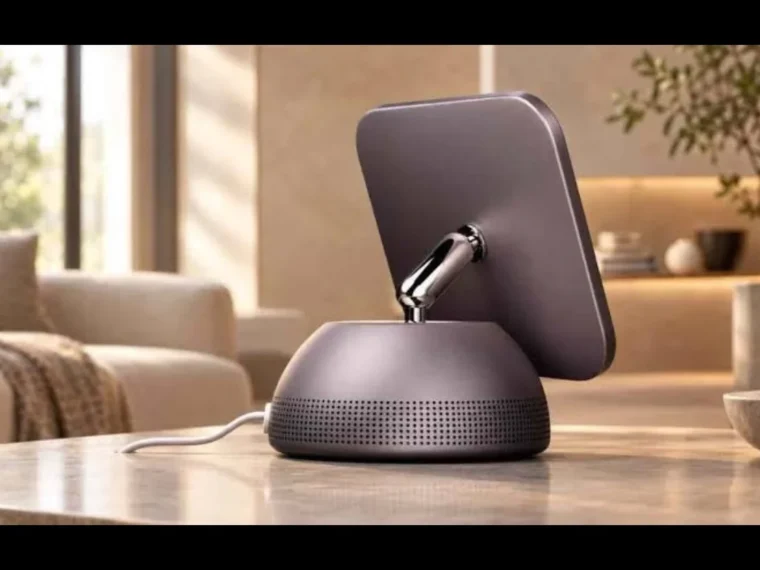
Apple’s new smart home screen is finally priced like something you might actually put in the kitchen. Apple HomeView was announced on 13 October 2026, costs $299 in the US for both the tabletop and wall-mounted models, and goes on sale on Friday, 13 November. It is powered by Siri AI, runs on an A18 chip, and is aimed squarely at becoming the shared household screen that still feels personal to each person who walks up to it.
Here is what HomeView is, what it costs in the markets that can buy it, what it can and cannot do, and how to decide whether it belongs on your counter before the holiday rush.
Apple HomeView price and release date
According to Apple’s newsroom announcement:
- Price: $299 (US) for Apple HomeView and $299 for Apple HomeView (Wall Mounted).
- Pre-orders: opened 13 October in the US, UK, Canada, Australia, New Zealand and India; Singapore followed on 15 October.
- Availability: Friday, 13 November 2026.
- Tabletop colours: silver, starlight, rose pink, space gray.
- Wall-mounted colours: space gray and silver.
Wall mounts are sold separately through Schneider Home. The Power Mount USB-C Wall Connector starts at $59.95, the Power Mount AC Wired at $79.95, and a Power Mount PoE Wired is due in early 2027 at $129.95.
One major caveat: Apple says HomeView is not available for sale in the European Union because Siri AI is currently unavailable in iOS there. Apple says it is working with the EU on a path forward. UK customers can buy it; most of the EU cannot, at least at launch.
What you get: display, sound and Siri AI
HomeView is built around a 7-inch Liquid Retina display on a hinged aluminum body with a domed speaker base. Apple rates peak brightness at 500 nits and a nightstand low of 0.3 nits, with True Tone and distance-aware interface scaling so the screen is readable from across a room and denser when you step closer.
Audio is a big part of the pitch: two full-range drivers in the display for Spatial Audio, plus a down-firing woofer and dual force-cancelling passive radiators in the base. The wall-mounted version uses two custom drivers tuned for on-wall placement.
The software story is Siri AI. Apple describes it as a more conversational assistant with broad world knowledge, onscreen awareness and, when paired with an Apple Intelligence-enabled iPhone or iPad, personal context from apps such as Messages and Calendar. Conversations can continue in the Siri app across iPhone, iPad, Mac, Apple Watch or Apple Vision Pro. Siri AI on HomeView launches in English in the US, Australia, Canada, India, New Zealand, Singapore, South Africa and the UK.
Who it is for in a shared home
HomeView can recognise up to six people by face and switch to a personal Home Screen with private Messages, Calendar, Reminders and Find My content. Shared photo albums and music stay household-friendly. Apple is clear that personal content only surfaces when the enrolled user is recognised and their paired iPhone or iPad is present and was recently unlocked.
That multi-user design is the main reason HomeView is more interesting than “another kitchen iPad.” A shared tablet usually becomes one person’s device. HomeView is meant to flip identity as people walk past.
Day-to-day uses Apple highlights include:
- Apple Music, Podcasts, News and Apple TV, plus compatible third-party apps
- FaceTime with Center Stage
- Intercom to other HomeView, HomePod and personal Apple devices
- Hands-free timers and step-by-step recipe help in the kitchen
- Smart home controls for lights, locks, thermostats and cameras
- Home Camera face with up to nine live video feeds
Camera intelligence features such as person, pet, package and vehicle recognition need a supported iCloud+ plan. That matters for total cost of ownership if you are buying HomeView mainly as a security dashboard.
How HomeView fits the wider AI gadget rush
HomeView did not land alone. In the same mid-October window, Microsoft showed an Nvidia RTX Spark Windows laptop from $2,599 and Amazon launched Alexa-branded tablets, with the Alexa Tablet 12 Pro at $550. CNBC framed the moment as tech giants racing to get AI gadgets on shelves for the holidays, with analysts warning that volumes may stay modest at first while companies train customers on the new assistants.
Against that backdrop, $299 for a dedicated household screen looks deliberate. Counterpoint Research analyst Mohit Agrawal told CNBC that Apple appeared to prioritise ecosystem adoption over maximum hardware margin. Whether that pays off depends on whether people want a new screen at all, or just better Siri on devices they already own.
Should you pre-order?
Buy HomeView soon if:
- You already live in Apple’s HomeKit or Matter setup and want a proper household hub with a screen.
- Multiple people share your home and a single iPad login is annoying.
- You want FaceTime, music and cameras in the kitchen or hallway without parking a full tablet there.
- You are in a launch country (and not waiting on EU availability).
Wait if:
- You are in the EU and cannot buy it yet.
- You mainly want better Siri on your phone; HomeView will not fix that by itself.
- You would need several paid mounts, cameras and a higher iCloud+ tier to get the setup you imagine. Add those costs before you call it a $299 purchase.
- You are already stretching for an iPhone Duo or other November Apple hardware. Our Apple Pro and Tell October 28 preview covers the Mac and iPad news still to land this month.
For the official specs, colours and market list, start with Apple’s HomeView newsroom post.
Privacy details worth reading before you buy
Apple is leaning hard on privacy as a differentiator against always-listening living-room gadgets. HomeView and the A18 chip include Secure Exclaves that process camera and microphone data separately from the rest of the system. Apple says that data cannot be accessed by HomeView software, apps, the user or Apple. Siri requests can run on-device or through Private Cloud Compute, which Apple says does not store the data or make it available to Apple.
That does not make the device invisible. It still has a camera and microphones. If you share a flat with housemates, talk through where it will sit and who is enrolled before you mount it in a hallway that everyone walks through in pyjamas. The product is designed for households; consent still matters.
Total cost checklist
Before you treat HomeView as a simple $299 outlay, add:
- Wall mount hardware if you want the wall model
- Any HomeKit or Matter accessories you expected to control on day one
- An iCloud+ plan if camera history and intelligent recognition are part of the appeal
- The time cost of setting up face recognition for everyone who should be recognised
Apple Home Collection cameras, thermostats and locks start arriving from December, with some accessories in early 2027. If your plan depends on those accessories, HomeView may be an early hub purchase ahead of a longer setup.
FAQ
How much does Apple HomeView cost?
$299 in the US for both the tabletop and wall-mounted models. Wall mounts cost extra.
When is Apple HomeView released?
Friday, 13 November 2026, after pre-orders that opened on 13 October 2026.
Can I buy HomeView in the EU?
Not at launch. Apple says it is unavailable in the EU while Siri AI is unavailable in iOS there. The UK is on the launch list.
What chip does HomeView use?
Apple and launch coverage point to the A18 chip, with Secure Exclaves for camera and microphone processing.
Does HomeView replace a HomePod or Apple TV?
Not exactly. It is strongest as a shared household display and control centre. HomePod mini 2 arrives earlier on 30 October, and a new Apple TV 4K also lands on 13 November if video is your priority.