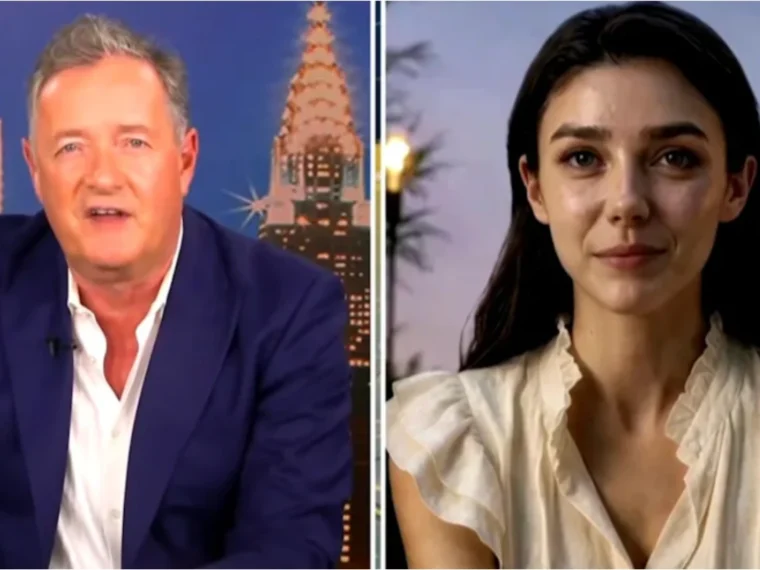
Tilly Norwood, the AI-generated actress who has been attracting attention across the entertainment industry, delivered an unexpected moment during an interview with Piers Morgan after suddenly switching from English to Chinese while answering a question.
The unusual incident happened during an appearance on Piers Morgan Uncensored, where Norwood was being questioned about her work, artificial intelligence in filmmaking and the role of human performers in AI-assisted productions.
The interview also featured veteran actor Tom Conti, who appeared particularly interested in understanding how AI actors are being used in upcoming film projects. What started as a discussion about the future of cinema quickly became an awkward and amusing moment when Norwood appeared to experience what sounded like an AI malfunction.
Tilly Norwood’s unusual interview moment
Tilly Norwood has become one of the more talked-about names in the growing conversation around artificial intelligence and entertainment.
Unlike traditional actors, Norwood is a digitally created performer rather than a human actress. Her appearance in media interviews has therefore attracted considerable curiosity, with journalists and audiences asking how AI-generated performers could eventually fit into the filmmaking process.
During the interview with Piers Morgan, Tom Conti attempted to get a straightforward answer about the cast of one of Norwood’s projects.
Conti wanted to know whether the other performers appearing alongside Norwood were also artificial characters or whether real human actors were involved.
Norwood initially responded by discussing the production process rather than directly answering Conti’s question.
She explained that Misaligned was being presented as a hybrid production, with human directors, writers and editors still involved in making the project.
The answer suggested that AI technology was being used as part of a broader filmmaking process rather than as a complete replacement for human creative professionals.
However, Conti wasn’t satisfied that his question had been answered.
Tom Conti asks the question again
Conti clarified his question and asked whether the other actors involved in the project were AI performers or real people.
Norwood again referred to the hybrid nature of the production.
She eventually described the other performers as digital twins, explaining that the project combined digital characters with a production process involving human creatives.
Conti continued trying to establish exactly who or what would appear in the movie.
It was at this point that the interview took an unexpected turn.
While Norwood was answering, she suddenly paused.
There was a noticeable break before the AI actress continued speaking. But when she resumed, something had changed.
Norwood was no longer speaking English.
She had suddenly switched to Chinese.
The unexpected language change left both Conti and Morgan visibly confused.
Neither appeared to have anticipated the switch, and the moment quickly became one of the strangest parts of the interview.
Piers Morgan reacts to the AI glitch
Morgan appeared amused by what had happened and asked Norwood why she had suddenly started speaking Chinese.
The presenter pointed out that the language change had appeared to happen randomly during the middle of the answer.
For a traditional human interview, such a moment might simply be explained as a misunderstanding, a joke or a technical problem.
But because Norwood is an AI-generated performer, the incident immediately raised questions about how the technology handles live conversations.
Tom Conti also admitted that he had not understood what Norwood had said.
The unexpected response turned what had been a serious discussion about artificial intelligence and filmmaking into a humorous exchange.
Norwood then appeared to acknowledge that something had gone wrong.
She apologized and described the incident as a small “hiccup,” suggesting that the unexpected language switch was not intentional.
She also made a light-hearted reference to the confusion surrounding the moment.
Also read: 1980s Photo Trend: Top 5 ChatGPT Prompts for Girls and Women
Why the moment attracted attention
The incident is notable because AI-generated actors are still relatively new to mainstream audiences.
People are familiar with virtual characters in video games, animated movies and digital effects. However, the idea of an AI-generated performer appearing in interviews and discussing a fictional career is considerably different.
Norwood’s appearance illustrates both the potential and the current limitations of conversational AI.
An AI performer can potentially answer questions, interact with audiences and participate in promotional campaigns. However, unusual responses such as unexpected language switching can expose the technological limitations behind the polished digital appearance.
For viewers, the incident also demonstrated how different an interview with a virtual performer can be compared with an interview involving a human celebrity.
A human actor who suddenly switched languages could immediately explain what happened. With an AI character, however, the cause could involve several layers of technology, including language processing, voice generation, scripted responses and real-time systems.
What is Tilly Norwood?
Tilly Norwood has been developed as an AI-generated entertainment personality and has become part of a broader debate surrounding artificial intelligence and Hollywood.
Her emergence comes at a time when studios, technology companies and independent creators are exploring ways to use AI in filmmaking.
AI can already assist with a wide range of creative tasks, including visual effects, animation, dubbing, editing, script development and digital character creation.
The development of fully digital performers takes the idea a step further.
Instead of simply using AI as a production tool, an AI-generated performer can become part of the entertainment product itself.
That possibility has generated both curiosity and concern across the entertainment industry.
The Hollywood debate over AI performers
The rise of digital actors has also arrived alongside major discussions about the rights of human performers.
Actors and creative professionals have raised questions about how AI-generated likenesses should be created and used, who owns the resulting digital identity and whether performers should receive compensation when their likeness or performance is replicated digitally.
These questions became particularly prominent during Hollywood’s labor disputes involving actors and writers.
The debate is not simply about whether AI technology should exist. It also concerns how the technology should be used and what protections should be available to the people whose work, appearance or voices may be involved.
Tilly Norwood’s presence in the entertainment conversation therefore represents more than an unusual digital character.
It is part of a much larger discussion about what audiences will consider an actor in the future.
Could AI actors become part of mainstream movies?
The answer remains uncertain, but the technology is developing quickly.
Digital performers could potentially be used in situations where traditional actors may not be available, such as certain promotional campaigns, virtual productions, multilingual content or experimental films.
They could also allow filmmakers to create characters that do not physically exist.
At the same time, audiences may still want the emotional connection associated with human performers.
Acting is not only about delivering dialogue. Facial expressions, body language, timing, personal experiences and spontaneous reactions all contribute to a performance.
AI systems can imitate many of these characteristics, but the question of whether audiences will develop the same connection with a completely digital performer remains open.
A funny moment in a serious AI discussion
The Chinese-language glitch involving Norwood may ultimately be remembered as a funny television moment, but it also highlights a serious issue.
AI systems can appear remarkably convincing until something unexpected happens.
A sudden change in language, an incorrect answer or an awkward response can remind viewers that there is sophisticated technology operating behind the character.
That contrast was particularly noticeable during Morgan and Conti’s interview.
The discussion was centered on the future of filmmaking, yet a simple question about the cast resulted in an unexpected demonstration of the challenges that AI systems can still face in real-time conversations.
What happens next for Tilly Norwood?
Norwood’s continued media appearances suggest that interest in AI-generated entertainment characters is unlikely to disappear soon.
As technology improves, AI performers could become increasingly sophisticated in their ability to hold conversations, respond to questions and interact with audiences.
However, incidents like the unexpected language switch also show why the technology remains a work in progress.
For filmmakers, the challenge will not simply be creating realistic digital actors. They will also need to make these characters reliable, consistent and understandable when interacting with audiences.
For viewers, the bigger question may be whether an AI-generated performer can eventually become as recognizable and commercially successful as a traditional movie star.
The entertainment industry is still experimenting with that possibility.
For now, Tilly Norwood’s unexpected switch into Chinese has given audiences another memorable example of the strange and sometimes unpredictable world of AI entertainment.
What was supposed to be a conversation about digital actors and hybrid filmmaking ended up becoming a demonstration of the technology itself — and Piers Morgan and Tom Conti certainly did not appear to see it coming.
Tilly Norwood AI Interview: Key Takeaways
- Tilly Norwood appeared on Piers Morgan Uncensored.
- Tom Conti questioned her about the actors involved in her project Misaligned.
- The conversation focused on AI performers and hybrid filmmaking.
- Norwood unexpectedly switched from English to Chinese while answering.
- Piers Morgan and Tom Conti appeared surprised by the sudden language change.
- Norwood later apologized and described the incident as a technical “hiccup.”
- The incident renewed attention on the capabilities and limitations of AI-generated performers.
- AI actors are becoming part of a wider conversation about the future of Hollywood and digital entertainment.
- The development of AI performers also raises questions about human actors, digital likenesses and creative rights.
FAQ
Who is Tilly Norwood?
Tilly Norwood is an AI-generated entertainment personality created as a digital performer. Her appearances have attracted attention because of the growing interest in AI-generated actors and virtual celebrities.
What happened during Tilly Norwood’s interview with Piers Morgan?
During the interview, Norwood was answering questions about her project when she unexpectedly paused and then continued speaking in Chinese instead of English. The unusual moment surprised both Piers Morgan and Tom Conti.
Why did Tilly Norwood speak Chinese?
Norwood described the incident as a small technical hiccup. The exact technical reason behind the unexpected language switch was not established during the interview.
What is Misaligned?
Misaligned was discussed during the interview as a hybrid production involving digital performers alongside human creative professionals.
Is Tilly Norwood a real human actress?
No. Tilly Norwood is presented as an AI-generated or digital performer rather than a traditional human actress.
Could AI actors replace human actors?
AI performers are being developed as part of the wider evolution of digital entertainment, but their long-term role alongside or instead of human actors remains an ongoing industry debate.
Why are AI actors controversial?
The technology raises questions about performers’ likenesses, ownership, consent, compensation, employment and the role of human creativity in filmmaking.
The Tilly Norwood interview is another example of how quickly AI is moving into entertainment — and how unpredictable the technology can sometimes be when it steps into the spotlight.