
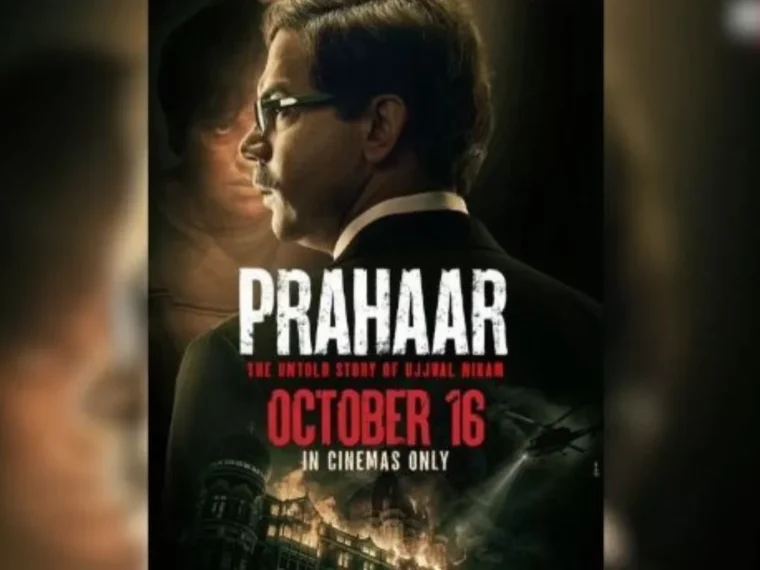
I went into Prahaar half expecting a flag-waving sermon. The 26/11 attacks have been filmed so many times, from so many angles, that another Bollywood take on Mumbai’s worst week felt like it would need a very good reason to exist. Avinash Arun’s film finds one. It doesn’t live on the streets of the siege. It moves into the courtroom that came after, and stays there for most of its 140 minutes. That choice, more than any single performance, is why this Prahaar movie review ends up being a recommendation, even with a few reservations attached.
The film opened in Indian cinemas on 16 October 2026, after being pushed back three times. Depending on which poster you look at, it is called Prahaar: The Untold Story of Ujjwal Nikam or Prahaar – The Ujjwal Nikam Story. Either way, it is a Maddock Films production, produced by Dinesh Vijan and certified U/A by the CBFC.
Prahaar at a Glance
The basics first:
- Director: Avinash Arun
- Writers: Sumit Roy, Vishal Tiwari
- Cast: Rajkummar Rao, Lalit Prabhakar, Jaideep Ahlawat, Sikandar Kher, Wamiqa Gabbi, Ashish Vidyarthi, Ritvik Sahore
- Music: Songs by Pritam, background score by Alokananda Dasgupta
- Runtime: 2 hours 20 minutes
- Certificate: U/A (India)
What the Film Is Actually About
Rajkummar Rao plays Ujjwal Nikam, the special public prosecutor best known for leading the case against Ajmal Kasab, the only gunman captured alive after the November 2008 attacks. Nikam has said publicly that this is a courtroom drama and not a biopic, and the film behaves exactly like one. We get glimpses of his earlier work, including the 1993 Bombay blasts trial, and a little of his home life with his wife Jyoti (Wamiqa Gabbi) and their son. But the engine of the story is the trial, and the strange problem at its heart.
Kasab was caught on camera. The case looked open and shut. Yet the state needed a trial that was not just quick but scrupulously fair, one that would hold up in front of the world. That tension, between wanting a verdict and needing a clean process, is where Prahaar is at its most interesting. If you followed the news back then you know how it ends, and the film is smart enough to make the “how” matter more than the “what”.
Performances: Rao Leads, but Prabhakar Steals Scenes
Rajkummar Rao as Ujjwal Nikam
Rao has built a career on playing real people, and he gets the outward things right here: the walk, the measured pitch of voice, the habit of letting a pause do the arguing. It’s a controlled, intelligent piece of work. My one complaint is that you can sometimes see the control. Several reviewers have noted his Marathi inflection slipping now and then, and I’d add that the performance occasionally feels more engineered than lived in. Anyone who remembers his raw turn as lawyer Shahid Azmi in Shahid will notice the difference. It’s still very good. It just isn’t the best thing in the film.
Lalit Prabhakar as Kasab
That honour goes to Lalit Prabhakar. The Marathi actor plays Kasab without a single cartoon-villain beat. Mainstream Hindi cinema usually gives us terrorists who snarl and shout. Prabhakar gives us a young man who shifts tone from scene to scene, sometimes defiant, sometimes oddly childlike, often impossible to read. It’s unsettling in the right way, and it makes the courtroom scenes crackle because you’re never sure which version of him will turn up.
Also read: Aasha Movie Review: Urvashi Shines in a Flawed ZEE5 Thriller
The Supporting Cast
Jaideep Ahlawat plays Chaudhary Zulfiqar, a Pakistani prosecutor who travels to India in connection with the case, and he is quietly superb. His conversations with Nikam over meals are some of the gentlest moments in the film, two tired men in black coats who understand each other’s burden better than anyone else in the room. Sikandar Kher, as defence lawyer Abbas Kazmi, is restrained and dignified, and the script deserves credit for treating the defence as a necessary part of the system rather than an enemy. Ashish Vidyarthi brings calm weight to the judge, M. L. Tahaliyani.
Wamiqa Gabbi is the casualty. She does what she can with the supportive-wife track, but the role is thin and predictable, and the film never gives her a scene that really belongs to her.
Direction, Writing and Pacing
Avinash Arun started out as a cinematographer, directed the Marathi film Killa and later worked on Paatal Lok, and you can feel that grounding. He doesn’t push the camera into your face or crank the volume to tell you when to feel things. The courtroom sequences are written with real care. Arguments land, counter-arguments land harder, and the legal procedure is explained without turning into a lecture.
Pacing is where opinions split, and I sit somewhere in the middle. The first half drops you into the proceedings fast and stays fairly dry. If you came in expecting thriller energy, you may get restless. The interval block, though, is strong, and the second half picks up noticeably. A child eyewitness, Komal, played with remarkable composure by young Dior Ranju Varghese, gives the film its most affecting stretch. Her testimony about the attack at CST station does more to convey the human cost of that night than any reconstructed gunfire could.
Where the film wobbles is tone. There are moments when it seems to want to be a careful legal procedural and a big crowd-pleasing patriotic drama at the same time. Mostly the procedural wins, which is a relief, but you can occasionally feel the commercial version tugging at its sleeve.
Music and Background Score
Sensibly, Prahaar doesn’t stop for song-and-dance numbers. The song “Mere Rehte”, sung by Vishal Mishra, is used with restraint and fits the mood. Alokananda Dasgupta’s background score is the more important contribution, building tension under the courtroom exchanges without drowning them out. You won’t leave humming anything, and that’s fine.
Is Prahaar Worth Watching in Theatres?
For anyone who lives in or loves Mumbai, I think it is. The city is not just a backdrop here. The film is, in its own way, about how a wounded city chose to answer through a courtroom rather than a mob. If you caught our Drishyam 3 review and liked that film’s police-versus-citizen chess game, Prahaar offers a sober, real-world version of the same kind of contest.
A word on suitability. The CBFC has passed it U/A, but the UK’s British Board of Film Classification flags strong bloody violence and injury detail, so think twice before taking younger children.
It is not a perfect film. Rao is a notch too careful, Gabbi is underused and the first half could lose ten minutes. But it treats a painful chapter of recent history with intelligence and decency, and it trusts its audience to sit with an argument. That is rarer than it should be.
Verdict: A gripping, grown-up courtroom drama carried by Lalit Prabhakar and Jaideep Ahlawat as much as by its star. Rating: 3.5/5
FAQ
When did Prahaar release and is it in theatres now?
Prahaar released in Indian cinemas on 16 October 2026 and is currently playing in theatres.
Is Prahaar a biopic of Ujjwal Nikam?
Not in the usual sense. It touches on Nikam’s career and family, but most of the film follows the trial of Ajmal Kasab after the 26/11 Mumbai attacks. Nikam himself has described it as a courtroom drama.
What is the runtime and certificate of Prahaar?
The film runs about 2 hours 20 minutes (140 minutes) and carries a U/A certificate from the CBFC in India.
Who plays Ajmal Kasab in Prahaar?
Marathi actor Lalit Prabhakar plays Kasab, and his performance is one of the most praised aspects of the film.